
Choosing the best intraoral scanner in 2026 isn’t just about brand it’s a clinical and financial call. With 30+ models, performance varies by use case: full-arch implants, Invisalign workflows, or budget-focused open file scanning. This comparison reviews every major scanner and breaks down accuracy, speed, software limits, subscriptions, and real chairside usability so Canadian dentists can choose based on facts, not sales claims.
Listen to a practical summary of the article in the short podcast below:
Below is a one-screen decision table you can use before reading the deeper sections. It includes every model we identified across your sources (30+). Prices are starting points and can shift with bundles, promos, service plans, and Canadian dealer packages. For rough CAD conversion, I used ~1 USD ≈ 1.36 CAD based on recent USD/CAD levels.
How to read this table (fast):
Legend (Ecosystem):
Open = routine export to common lab formats (STL/PLY/OBJ/DCM where applicable).
Closed / Semi-closed = workflow is strongly tied to the brand’s platform and/or export may be limited by plan, fees, or partner rules.
| Model | Company | Wireless | Weight | Scan speed (as marketed) | Claimed accuracy | File formats | Ecosystem | Subscription required | Starting price (USD / ~CAD) | Best for | Canada support |
| Primescan Connect | Dentsply Sirona | No | 457g | “1,000,000+ pts/sec”; depth ~20mm | STL/PLY (varies by workflow) | Semi-closed (DS Core / CEREC workflow) | Often yes (platform/services) | ~$24,000 / ~$32,640 | Restorative, CEREC workflows | Yes (common) | |
| Primescan | Dentsply Sirona | No | “1,000,000+ pts/sec”; depth ~20mm | STL/PLY (varies) | Semi-closed | Often yes | Restorative, chairside | Yes | |||
| Primescan 2 | Dentsply Sirona | STL/PLY (varies) | Semi-closed | Often yes | Restorative + DS Core users | Yes | |||||
| CEREC Primescan | Dentsply Sirona | No | STL/PLY (varies) | Semi-closed (CEREC) | Often yes | Chairside CEREC | Yes | ||||
| CEREC Omnicam | Dentsply Sirona | No | STL (varies) | Closed / older CEREC | Often yes | Legacy CEREC users | Limited (legacy) | ||||
| TRIOS 6 | 3Shape | Yes | 308g | 2400 images/sec | “Clinically validated” (brand claim) | PLY, DCM, STL | Open (exports) + strong 3Shape workflow | Often yes (platform/apps) | ~$27,900 / ~$37,944 | GP/Ortho/Restorative; patient comms | Yes |
| TRIOS 5 | 3Shape | Yes/No | 299g | PLY, DCM, STL | Open + strong 3Shape workflow | Often yes | ~$26,000 / ~$35,360 | GP/Ortho/Restorative | Yes | ||
| TRIOS 4 | 3Shape | PLY, DCM, STL | Open + strong 3Shape workflow | Often yes | Mixed workflows | Yes | |||||
| TRIOS 3 | 3Shape | PLY, DCM, STL | Open + strong 3Shape workflow | Often yes | Mixed workflows | Yes | |||||
| iTero Lumina | Align (iTero) | STL (restorative export via partners/plans) | Closed / Invisalign-first | Often yes (plan/platform) | Invisalign, monitoring | Yes | |||||
| iTero Element 5D+ Mobile | Align (iTero) | No | 470g | “Full arch ~60s” | NIRI features (brand claim) | Restorative STL via partners | Closed / Invisalign-first | Often yes | ~$42,000 / ~$57,120 | Invisalign, monitoring | Yes |
| iTero Element 5D | Align (iTero) | “Full arch ~60s” | Restorative STL via partners | Closed / Invisalign-first | Often yes | Invisalign | Yes | ||||
| iTero Element Plus Series | Align (iTero) | Restorative STL via partners | Closed / Invisalign-first | Often yes | Invisalign | Yes | |||||
| iTero Element 2 | Align (iTero) | Restorative STL via partners | Closed / Invisalign-first | Often yes | Invisalign | Yes | |||||
| iTero Element Flex | Align (iTero) | Restorative STL via partners | Closed / Invisalign-first | Often yes | Mobile iTero setups | Yes | |||||
| Medit i700 | Medit | Yes/No | “Up to ~70 fps” (brand claim) | STL, PLY, OBJ | Open | Often no/low recurring (varies) | ~$20,000 / ~$27,200 | Value pick; labs; GP | Yes (common) | ||
| Medit i700 Wireless | Medit | Yes | 328g | “Up to ~70 fps” | STL, PLY, OBJ | Open | Often no/low recurring (varies) | ~$20,000 / ~$27,200 | Value + mobility | Yes | |
| Medit i900 | Medit | 165g | STL, PLY, OBJ (common Medit workflow) | Open | Often no/low recurring (varies) | Lightweight daily scanning | Yes | ||||
| Medit i900 Classic | Medit | STL, PLY, OBJ | Open | Often no/low recurring (varies) | Value + simplicity | Yes | |||||
| Aoralscan 3 | SHINING 3D | Yes/No | ~15 fps (as cited in summaries) | STL, PLY, OBJ | Open | Varies | Value + ortho tools | Yes (dealer-dependent) | |||
| Aoralscan 3 Wireless | SHINING 3D | Yes | 330g | ~15 fps | STL, PLY, OBJ | Open | Varies | ~$14,000 / ~$19,040 | Wireless value | Yes (dealer-dependent) | |
| Aoralscan Elite | SHINING 3D | 124g | STL, PLY, OBJ | Open | Varies | ~$19,999 / ~$27,199 | Lightweight; mixed workflows | Yes (dealer-dependent) | |||
| Dexis IS 3800W | Dexis (Envista) | Yes | 240g | “Single arch ~25s” | STL (common), others vary | Semi-open (workflow depends) | Varies | ~$20,000 / ~$27,200 | Fast single-arch | Yes | |
| Carestream CS 3800 | Carestream (legacy) | Yes/No | STL (common) | Semi-open | Varies | Existing CS users | Limited (legacy) | ||||
| CS 3700 | Carestream | STL (common) | Semi-open | Varies | Existing CS users | Limited (legacy) | |||||
| Virtuo Vivo | Straumann / Dental Wings | No | 130g | STL (and Straumann workflows) | Open + Straumann workflows | Varies | ~$22,000 / ~$29,920 | Light wand; mixed restorative | Yes | ||
| Straumann SIRIOS | Straumann | Yes | 245g (incl. battery) | STL, PLY | Open + Straumann workflows | Varies | GP/Ortho; Straumann users | Yes | |||
| Planmeca Emerald S | Planmeca | No | 229g | “Full arch < 1 min (trained user)” | STL, PLY | Open | Varies | ~$13,000 / ~$17,680 | GP; comfort + caries tools | Yes (dealer-dependent) | |
| Launca DL-300 | Launca | No/Yes (some configs) | 230g | STL/PLY/OBJ (commonly stated) | Open (most workflows) | Varies | ~$22,000 / ~$29,920 | Budget-to-mid tier | Dealer-dependent | ||
| Launca DL-206 | Launca | STL/PLY/OBJ (commonly stated) | Open | Varies | Legacy Launca users | Dealer-dependent | |||||
| 3Disc Heron | 3Disc | No | 165g | STL, PLY, OBJ | Open | Varies | ~$17,000 / ~$23,120 | Open lab workflows | Dealer-dependent | ||
| 3Disc OVO | 3Disc | STL/PLY/OBJ (commonly stated) | Open | Varies | Newer 3Disc users | Dealer-dependent | |||||
| Alliedstar Sensa | Alliedstar | 230g | STL, PLY, OBJ | Open | Varies | ~$13,995 / ~$19,033 | Value; open exports | Dealer-dependent | |||
| Straumann (Digital Wings) Virtuo series (other) | Straumann / Dental Wings | STL/PLY (varies) | Open + Straumann workflows | Varies | Straumann clinics | Yes |
Notes (so you don’t get burned by fine print):
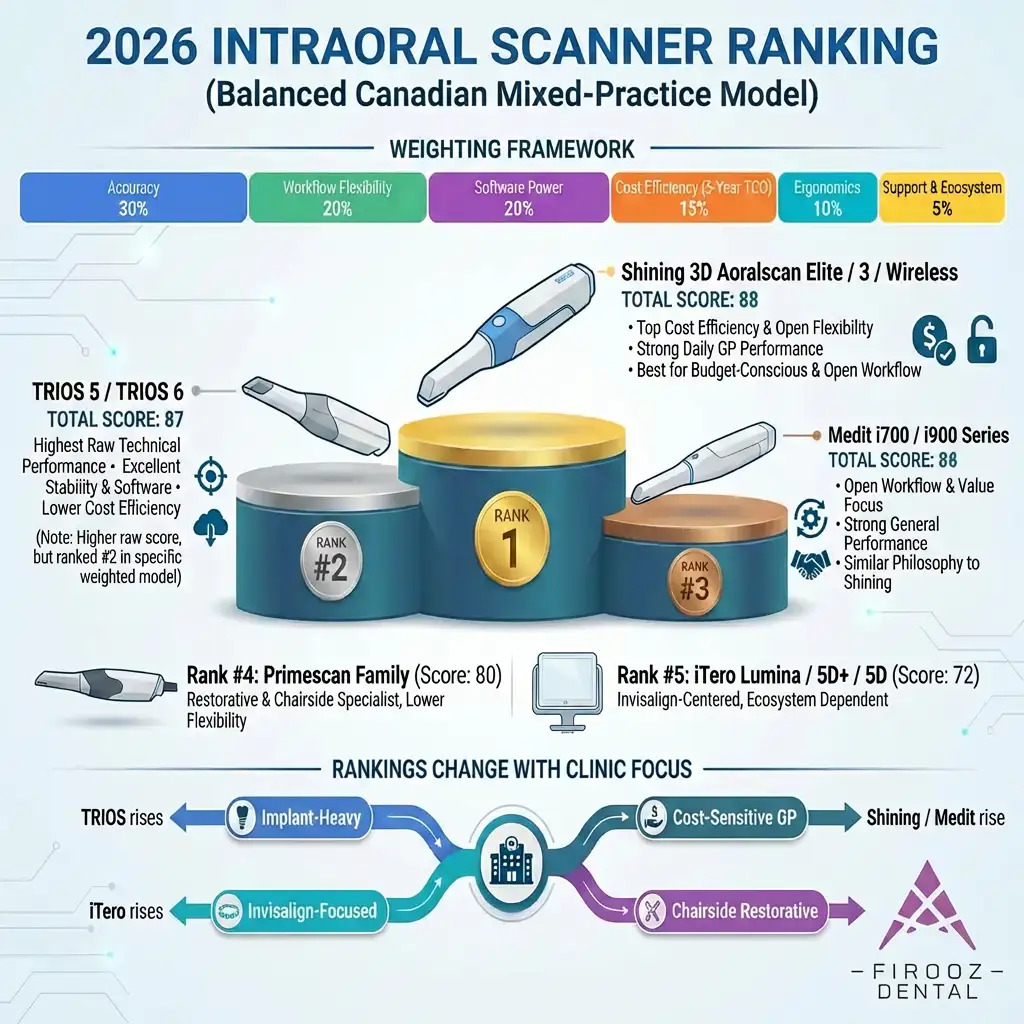
This ranking follows the same weighted framework defined earlier:
The weights reflect a balanced Canadian mixed-practice clinic (GP + restorative + some implants + moderate ortho).
If your clinic profile is different, your ranking will shift accordingly.
| Rank | Scanner / Family | Accuracy (30%) | Workflow Flexibility (20%) | Software (20%) | Cost Efficiency (15%) | Ergonomics (10%) | Support (5%) | Total Score (100) | Best Fit For |
| 1 | Shining 3D Aoralscan Elite / 3 / Wireless | 25 | 19 | 18 | 15 | 8 | 3 | 88 | Budget-Conscious + Open Workflow Clinics |
| 2 | TRIOS 5 / TRIOS 6 | 27 | 18 | 19 | 11 | 8 | 4 | 87 | Balanced GP + Implants + Ortho |
| 3 | Medit i700 / i900 Series | 25 | 19 | 16 | 13 | 8 | 3 | 84 | Open Workflow + Value |
| 4 | Primescan Family (Primescan / Connect / 2 / CEREC) | 26 | 15 | 18 | 9 | 7 | 5 | 80 | Restorative + Chairside |
| 5 | iTero Lumina / 5D+ / 5D | 23 | 12 | 18 | 8 | 7 | 4 | 72 | Invisalign-Centered Practices |
| 6 | Dexis IS 3800W | 22 | 15 | 14 | 11 | 9 | 3 | 74 | Fast GP Restorative |
| 7 | Straumann SIRIOS / Virtuo Vivo | 22 | 16 | 15 | 10 | 8 | 3 | 74 | Implant-Focused Clinics |
| 8 | Alliedstar Sensa | 20 | 18 | 13 | 15 | 7 | 2 | 75 | Cost-Sensitive Entry Digital |
| 9 | 3Disc Heron / OVO | 20 | 17 | 13 | 14 | 7 | 2 | 73 | Open Lab Workflows |
| 10 | Planmeca Emerald S | 20 | 15 | 14 | 11 | 7 | 3 | 70 | Planmeca Ecosystem Users |
| 11 | Launca DL-300 | 19 | 17 | 12 | 15 | 7 | 2 | 72 | Entry-Level Digital |
Shining 3D leads this ranking because the weighting system rewards:
In a Canadian environment where many clinics prioritize:
Shining 3D becomes extremely competitive.
It may not lead in absolute clinical margin detail compared to premium systems, but it scores consistently across cost and flexibility which significantly boosts its total weighted score.
Even though Shining 3D appears first in this layout, TRIOS 5/6 still achieve the highest raw technical performance score.
They dominate in:
They lose points primarily in cost efficiency compared to open-value competitors.
If cost weighting were reduced, TRIOS would immediately move to the top.
Medit performs similarly to Shining in philosophy:
It scores slightly higher in clinical performance than Shining, but slightly lower in cost advantage in this model which keeps it just behind the top two.
For many Canadian clinics, Medit and Shining will be compared side-by-side.
Primescan performs exceptionally in:
However, lower workflow flexibility and higher long-term ecosystem cost reduce its total weighted score in a mixed-practice model.
If your clinic is restorative-dominant with chairside milling, Primescan may rank #1 in your customized matrix.
iTero excels when:
But in a scoring system that values:
its ecosystem dependency reduces overall ranking.
If Invisalign accounts for most of your revenue, its position would rise dramatically.
If we adjust the model:
This table reflects one balanced scenario not an absolute truth.
For a typical mixed Canadian GP practice:
🥇 Shining 3D Aoralscan Series
🥈 TRIOS 5 / 6
🥉 Medit i700 / i900
But the real winner depends on what your clinic does most not what ranks first in a generalized matrix.
Before ranking any best intraoral scanner 2026 picks, we used a consistent framework that separates marketing claims from chairside reality. Each model was scored across four areas: clinical accuracy, full-arch behavior, software/workflow constraints, and 5-year cost.
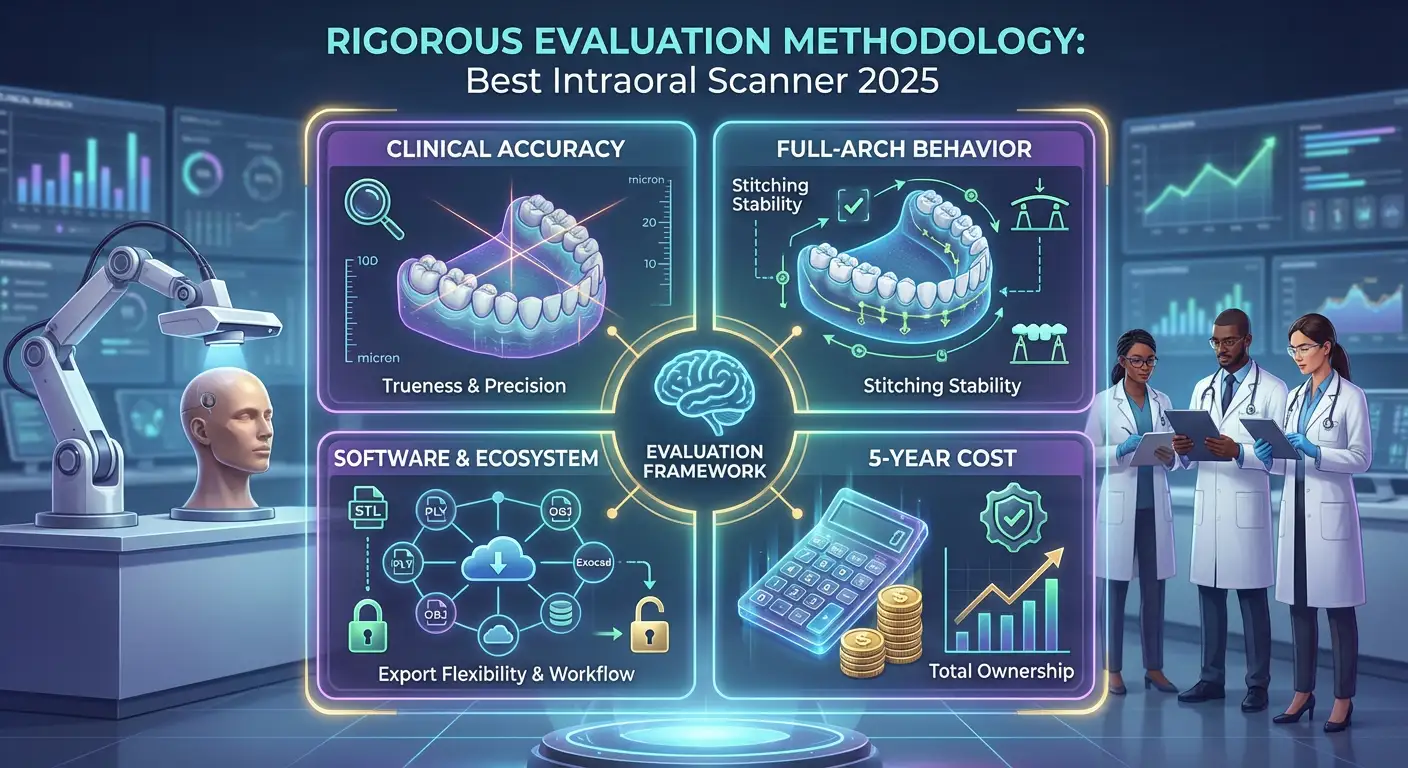
We looked at trueness (how close a scan is to the real geometry) and precision (how repeatable scans are). Priority went to situations that expose weaknesses: full-arch implant scanning, scanbody capture, and margin detail in restorative cases. Manufacturer micron claims were treated as “claims” unless supported by independent evidence.
Many scanners look great on a single crown but drift over long spans. We checked for stitching stability and whether rescans/retracing stay consistent rather than degrading the model.
Hardware is only half the decision. We evaluated export flexibility (STL/PLY/OBJ/DCM where applicable), open vs restricted workflows, and practical compatibility with common lab and clinic systems (e.g., Exocad and major vendor platforms). We also accounted for ongoing platform rules that affect everyday use.
We estimated total ownership using a simple model: purchase price + any recurring software fees + tip/consumable costs + warranty/service plans + platform/storage costs. This is where “cheap upfront” can become expensive.
To keep this comparison fair, we included all major brands and clearly separated independent data from manufacturer statements. Rankings are based on the scoring framework above not popularity, dealer preference, or ad spend.
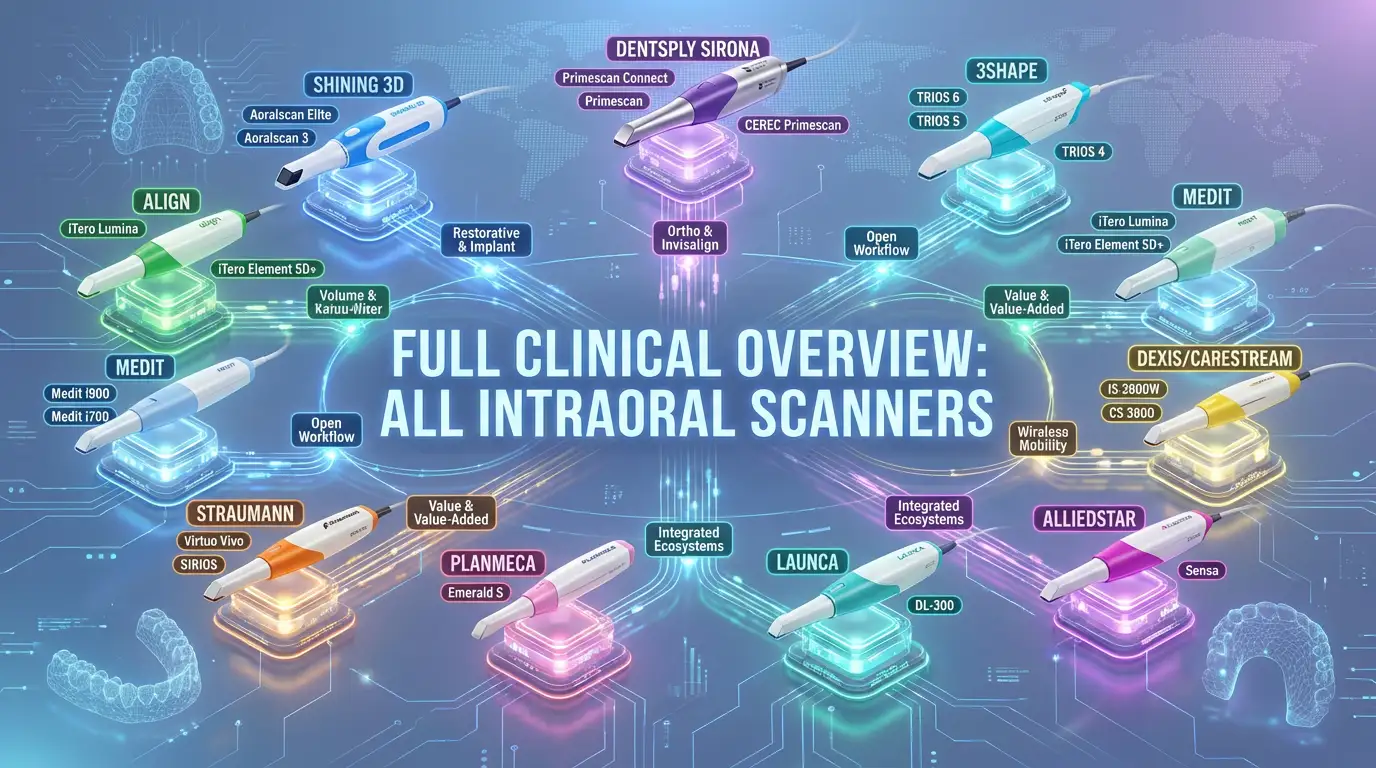
Aoralscan Elite
Position
Lightweight, newer hardware in value segment.
Strengths
Best For
Cost-sensitive clinics
Mixed GP workflows
Aoralscan 3 / 3 Wireless
Strengths
Limitations
Best For
Budget-conscious buyers
Clinics prioritizing open file flexibility
Primescan / Primescan Connect / Primescan 2 / CEREC Primescan
Market Position
Premium restorative-focused ecosystem. Common in clinics committed to DS Core or CEREC workflows.
Clinical Strengths
Limitations
Best For
High-volume restorative clinics
Chairside crown workflows
Practices wanting tight integration and workflow control
Not Ideal For
Budget-sensitive clinics
Offices prioritizing completely open lab freedom
CEREC Omnicam (Legacy)
Position
Older generation scanner still present in many clinics.
Best For
Existing CEREC users maintaining legacy systems
Not Recommended For
New purchases unless heavily discounted
TRIOS 6
Market Position
High-end, feature-rich scanner with strong diagnostic and monitoring capabilities.
Strengths
Limitations
Best For
Digitally mature GP practices
Restorative + ortho hybrid clinics
Practices emphasizing patient engagement
TRIOS 5
Position
Balanced performance model in the TRIOS lineup.
Strengths
Best For
General practices wanting versatility
Clinics upgrading from older TRIOS models
TRIOS 4
Position
Mid-generation model still clinically capable.
Best For
Clinics wanting TRIOS ecosystem at lower entry price
TRIOS 3
Position
Older but still functional.
Best For
Budget-conscious buyers within TRIOS system
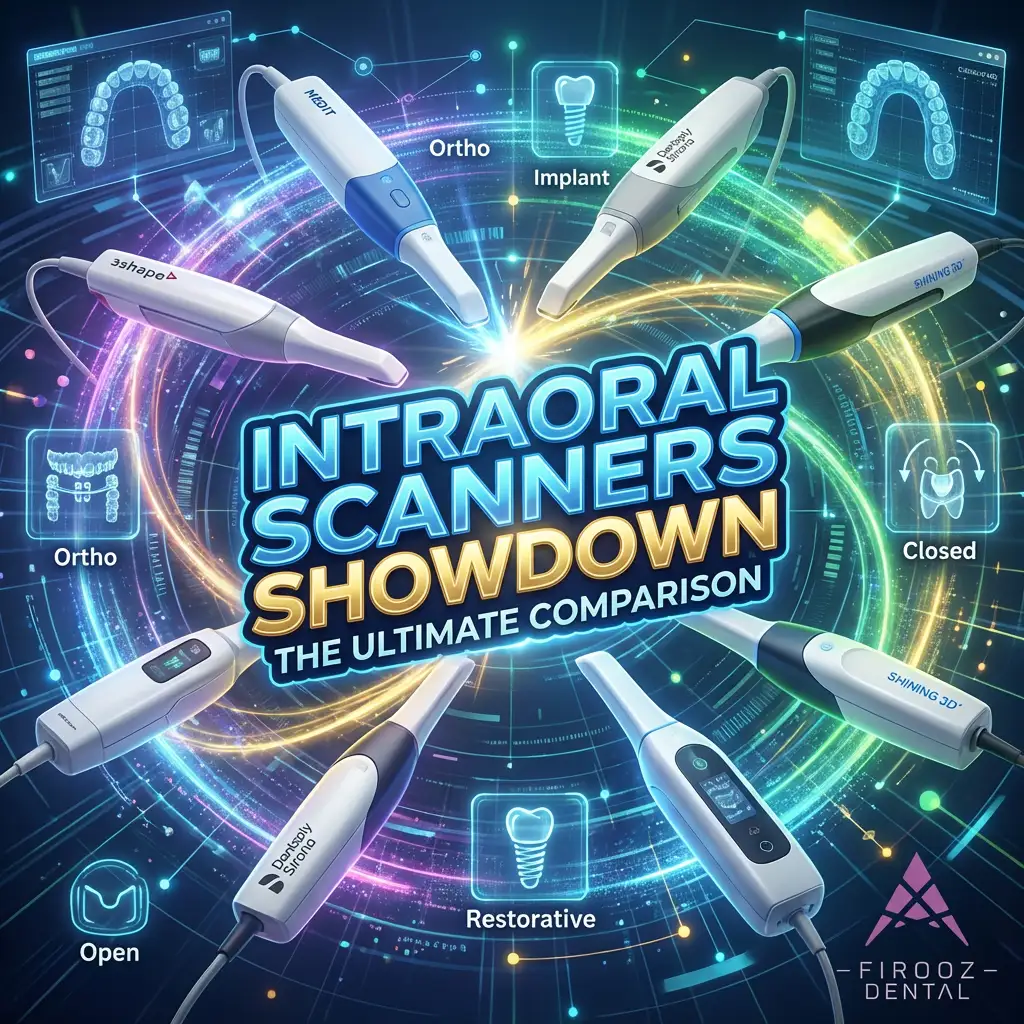
iTero Lumina
Position
Newest generation Invisalign-centered scanner.
Strengths
Limitations
Best For
Orthodontic and Invisalign-heavy clinics
iTero Element 5D+ / 5D
Strengths
Limitations
Best For
GP offices with heavy Invisalign volume
Monitoring-focused practices
iTero Element Plus / Element 2 / Flex
Position
Older generations.
Best For
Existing iTero users maintaining system
Invisalign-focused clinics on lower budget
Medit i900
Market Position
New lightweight generation emphasizing portability.
Strengths
Limitations
Best For
Clinics wanting open workflows
Value-conscious buyers
Implant and lab-focused offices
Medit i700 / i700 Wireless
Strengths
Best For
GP clinics transitioning to digital
Implant + restorative workflows
Budget-aware Canadian clinics
Medit i900 Classic
Position
Simplified version of i900.
Best For
Clinics wanting lighter hardware without premium extras
Dexis IS 3800W
Position
Wireless scanner from rebranded Carestream line.
Strengths
Best For
Clinics already using Dexis ecosystem
GP practices wanting wireless mobility
Carestream CS 3800 / CS 3700
Position
Legacy models still used in North America.
Best For
Existing Carestream users
Virtuo Vivo
Position
Lightweight scanner integrated into Straumann digital stack.
Strengths
Best For
Implant-focused practices
Straumann users
Straumann SIRIOS
Position
Straumann’s newer scanner offering.
Strengths
Best For
Straumann-heavy implant clinics
Planmeca Emerald S
Position
Scanner designed to integrate with Planmeca imaging systems.
Strengths
Best For
Clinics already invested in Planmeca ecosystem
Launca DL-300
Position
Mid-tier value scanner.
Strengths
Best For
Clinics prioritizing affordability
Practices wanting open lab workflow
Launca DL-206
Position
Older generation.
Best For
Budget entry buyers
3Disc Heron
Position
Open workflow-focused scanner.
Strengths
Best For
Lab-driven restorative clinics
3Disc OVO
Position
Updated model with improved hardware.
Best For
Clinics wanting open CAD compatibility
Alliedstar Sensa
Position
Newer value competitor.
Strengths
Best For
Cost-sensitive clinics
GP offices entering digital scanning
“Accuracy” in intraoral scanning isn’t one number. Clinically, it has two parts:
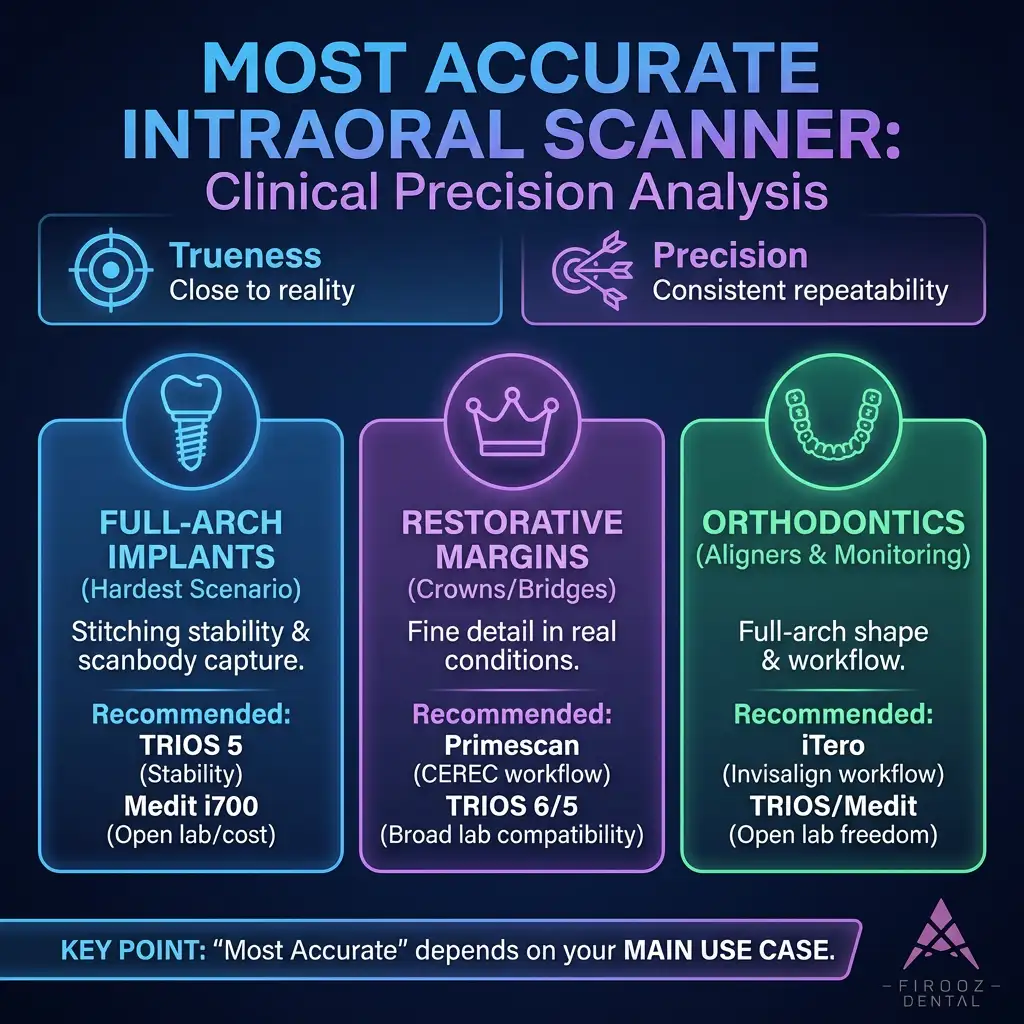
A scanner can look great on single crowns and still struggle on long-span scans (full arches) where small stitching drift accumulates. That’s why the “most accurate” choice depends heavily on what you scan most:
Where accuracy matters most (by clinical scenario)
1) Full-arch implants (hardest scenario)
This is where scanners are most likely to show distortion. What usually determines success here is:
Practical takeaway: If your practice is implant-heavy (especially full-arch), prioritize scanners with a strong track record in full-arch stability and scanbody workflows, plus a lab ecosystem you trust.
2) Restorative margins (crowns/bridges)
For margins, the winner is often the system that consistently captures fine detail under real conditions (saliva, subgingival areas, tissue movement). Chairside restorative workflows also benefit from:
3) Orthodontics (aligners and monitoring)
For ortho, “accuracy” is more about full-arch shape integrity and bite consistency, and less about subgingival margin detail. Workflow can dominate performance here:
Accuracy shortlist (what typically wins in real clinics)
Key point: “Most accurate” should be stated as most accurate for your main use case, not as one universal winner.
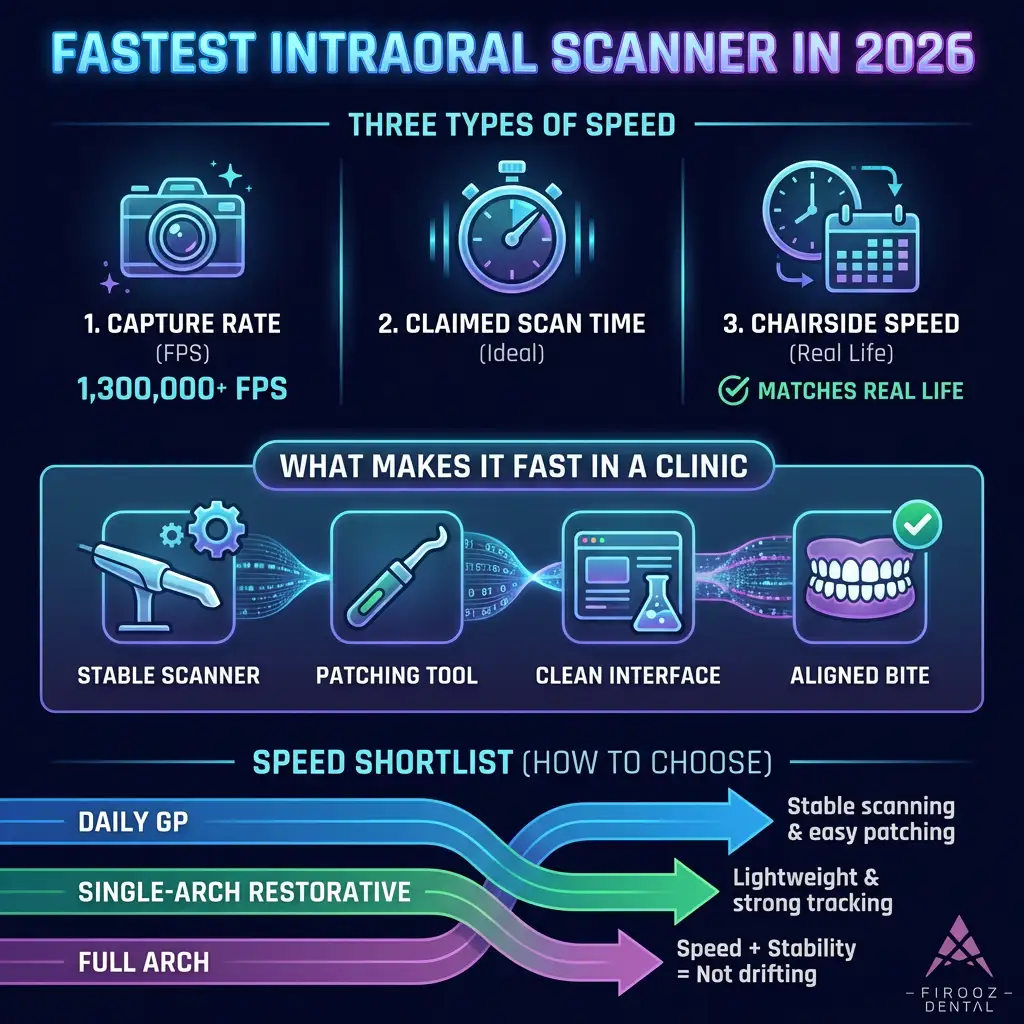
Speed is easy to oversimplify. There are three different “speeds,” and only one matches real life:
A scanner can advertise high capture rate but still feel slow if:
What makes a scanner feel fast in a busy clinic
The scanners that keep schedules on time usually share:
Speed shortlist (how to choose)
This table is intentionally use-case based (what it’s best for), not “one score fits all.” It helps you narrow down the right group fast, then we’ll rank in later sections.
| Scanner / Family | Best Accuracy Use Case | Best Speed Use Case | Why It Usually Performs Well | Watch-outs |
| 3Shape TRIOS 5 | Full-arch stability + implants (common shortlist) | Busy GP workflows | Strong scanning stability and broad clinical adoption | Cost can rise with software/app choices |
| 3Shape TRIOS 6 | Restorative + ortho + monitoring | Fast day-to-day scanning | Strong ecosystem tools, patient monitoring options | Premium pricing; platform costs may apply |
| Dentsply Sirona Primescan family (Primescan/Connect/2/CEREC) | Restorative margins + chairside workflows | Efficient restorative workflows | Strong restorative detail and chairside ecosystem fit | Higher upfront cost; workflow tends to be more ecosystem-tied |
| Medit i700 / i700 Wireless | Strong all-rounder; implants shortlists in open workflows | Often fast in real clinics | Open exports, good daily scanning performance, cost control | Performance depends on setup and training; ecosystem less vertically controlled |
| Medit i900 / i900 Classic | Mixed GP + restorative + lab workflows | Lightweight daily use | Very light form factor; open exports | Newer positioning means you still want dealer support clarity |
| iTero Lumina / Element 5D+ / 5D | Ortho monitoring + Invisalign workflows | Fast for aligner-heavy workflows | Submission + monitoring ecosystem fit | Less flexible for open lab freedom; costs depend on plans |
| Dexis IS 3800W | General restorative scanning | Single-arch speed focus | Lightweight and fast-feeling in short-span scans | Depends on dealer/service channel and workflow preferences |
| Shining 3D Aoralscan 3 / Wireless | Value segment; everyday GP | Often quick for basic scanning | Open exports; value pricing; useful tools | Service and dealer support varies more by region |
| Shining 3D Aoralscan Elite | Lightweight daily use | Quick handling and mobility | Very light; open exports | Validate support and workflow match in your province |
| Straumann Virtuo Vivo / SIRIOS | Straumann-centered implant/restorative workflows | Efficient within Straumann workflows | Good fit when your implants/lab chain matches | Value depends heavily on your existing Straumann stack |
| Planmeca Emerald S | Planmeca ecosystem clinics | Practical GP scanning | Good fit when Romexis environment is central | More ecosystem-dependent for maximum value |
| Launca DL-300 / DL-206 | Budget-to-mid tier open workflows | Adequate for routine scans | Often chosen for price + open exports | Verify support, software policy, and long-term ownership costs |
| 3Disc Heron / OVO | Open lab workflows | Practical daily scanning | Open exports; simple lab send | Confirm support and current availability |
| Alliedstar Sensa | Value + open workflows | Practical daily scanning | Often shortlisted on price with open exports |
When dentists ask “which intraoral scanner is the best,” the answer is often decided less by the wand and more by the ecosystem around it: file export rules, subscriptions, lab handoff, and what happens when you change labs, add a second location, or stop paying a monthly fee.
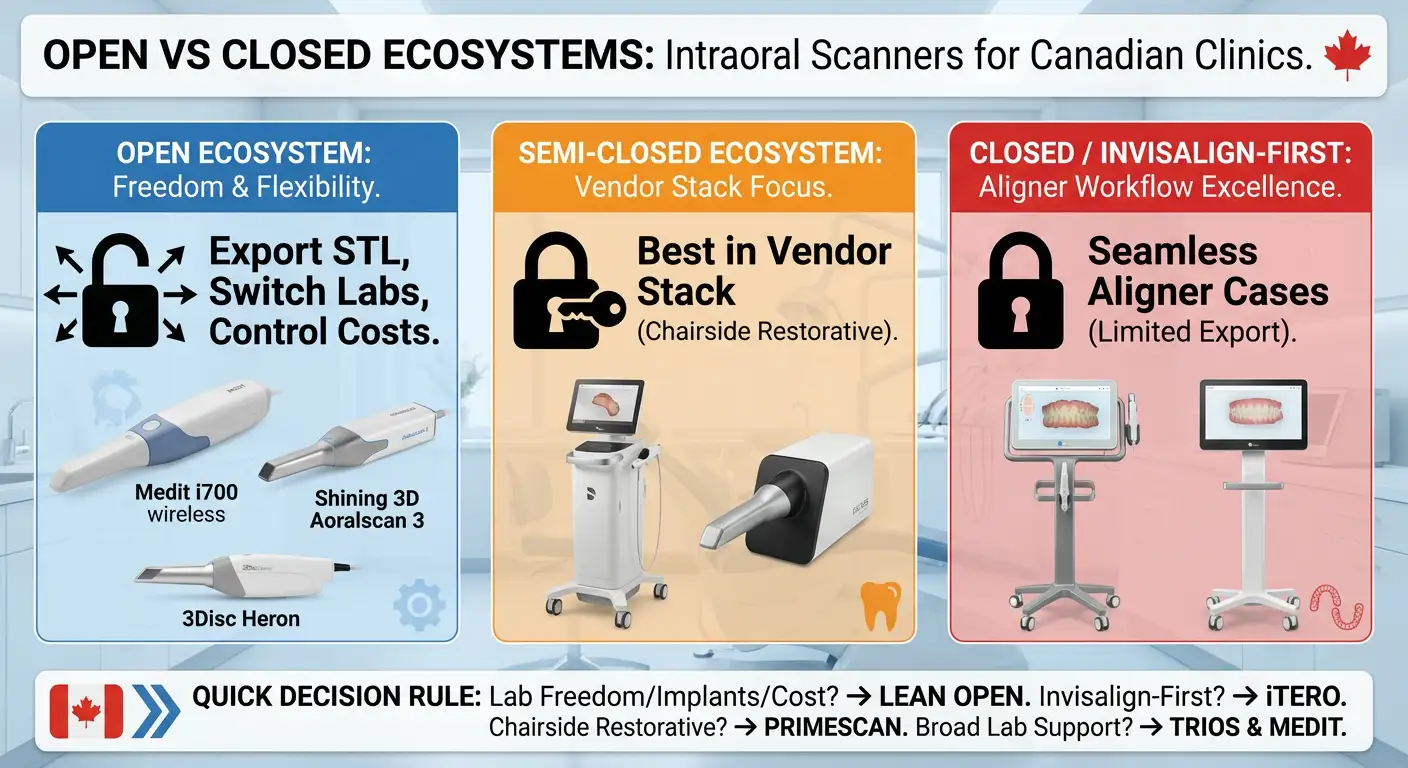
What “open” and “closed” mean in real life
Open ecosystem (practical meaning):
Commonly chosen for open-style workflows in this guide:
Closed or “Invisalign-first” ecosystem (practical meaning):
Most often seen here:
Semi-closed ecosystem (common in chairside restorative stacks):
Often seen here:
1) “Can I export STL (and do I need to pay extra for it)?”
This single question prevents a lot of buyer’s remorse.
What to ask the dealer (word-for-word):
2) “What will I pay over five years, not on day one?”
Many scanners look close in purchase price but differ sharply in:
Canadian reality: clinics often run scanners for years. A “cheap” purchase can become pricey if the plan is mandatory for daily use.
3) “Does my lab actually want files from this scanner?”
In Canada, lab compatibility is usually fine for mainstream systems, but the friction shows up in details:
Fast check: ask your top two labs:
4) “How does this ecosystem handle Invisalign, implants, and general lab work?”
A lot of clinics do a mix. The best ecosystem is the one that matches your mix.
5) “What does support look like in my province?”
This is where Canada differs from generic “best scanner” lists.
A scanner can be great on paper, but if your local service channel is slow, downtime hurts:
Dentsply Sirona (DS Core / CEREC path)
Best fit:
3Shape (Unite + TRIOS apps)
Best fit:
Medit (Medit Link ecosystem around open exports)
Best fit:
iTero (Align platform and submission routes)
Best fit:
This section is written the way Canadian buyers actually decide: by what they do most often, not by one generic winner. Each use case includes a shortlist plus a “watch-outs” box so you don’t buy the right scanner for the wrong clinic.
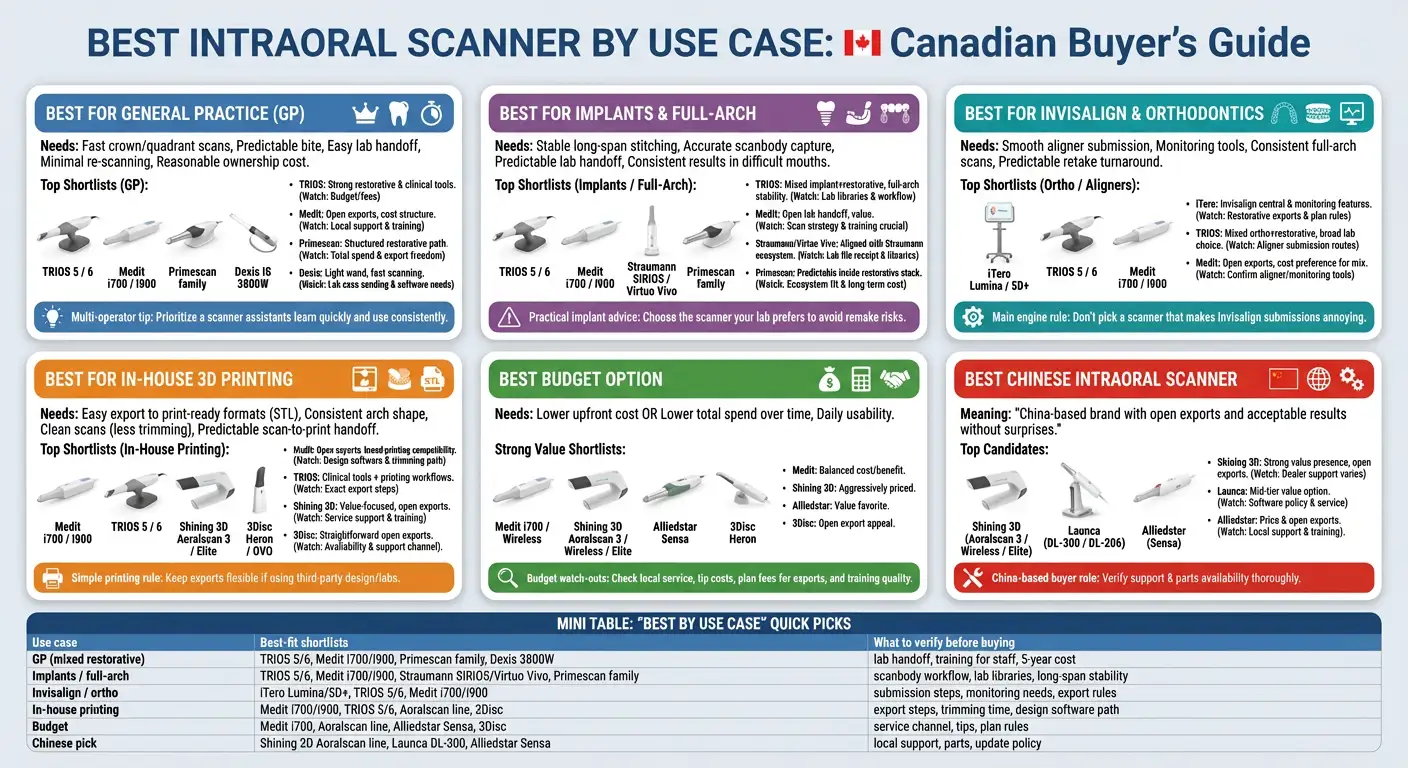
What GP clinics usually need:
Top shortlists (GP):
If you’re choosing for a multi-operator GP clinic:
Prioritize the scanner that your hygienists/assistants can learn quickly and use consistently. A scanner that only one person can scan well with becomes a bottleneck.
What implant clinics need:
Top shortlists (implants / full-arch):
Practical implant advice that saves remakes:
Choose the scanner your lab is happiest with for scanbody workflows. In implants, lab friction becomes remake risk.
What ortho/aligner clinics need:
Top shortlists (ortho / aligners):
If Invisalign is your main engine:
Don’t pick a scanner that makes Invisalign submissions annoying. Time loss here is real.
What in-house printing workflows need:
Top shortlists (in-house printing):
Simple printing rule:
If your printing depends on third-party design partners or different labs, keep exports flexible.
Budget buyers usually fall into two groups:
Strong value shortlists:
Budget watch-outs (don’t skip these):
A budget scanner that causes more retakes can cost more than an expensive scanner over a year of remakes and chair time.
In real Canadian buying conversations, “best Chinese intraoral scanner” usually means:
“Which China-based brand gets me open exports and acceptable daily results without surprises?”
Top candidates from this comparison:
China-based buyer rule:
Spend extra time verifying support and parts availability. The scanner is only as good as the service channel when something breaks mid-week.
| Use case | Best-fit shortlists (from this guide) | What to verify before buying |
| GP (mixed restorative) | TRIOS 5/6, Medit i700/i900, Primescan family, Dexis 3800W | lab handoff, training for staff, 5-year cost |
| Implants / full-arch | TRIOS 5/6, Medit i700/i900, Straumann SIRIOS/Virtuo Vivo, Primescan family | scanbody workflow, lab libraries, long-span stability |
| Invisalign / ortho | iTero Lumina/5D+, TRIOS 5/6, Medit i700/i900 | submission steps, monitoring needs, export rules |
| In-house printing | Medit i700/i900, TRIOS 5/6, Aoralscan line, 3Disc | export steps, trimming time, design software path |
| Budget | Medit i700, Aoralscan line, Alliedstar Sensa, 3Disc | service channel, tips, plan rules |
| Chinese pick | Shining 3D Aoralscan line, Launca DL-300, Alliedstar Sensa | local support, parts, update policy |
If you only compare the purchase price, you’ll almost always misjudge the real cost of an intraoral scanner. Total Cost of Ownership (TCO) means what you actually spend over five years to keep the scanner functioning daily: the initial hardware price, software or platform fees, tip replacements, service coverage, and any storage or subscription costs. In Canada, dealer bundles and provincial service quality can significantly affect this total.
A simple and fair comparison formula is:
5-Year TCO = Initial Price + (Annual Fees × 5) + Service/Warranty Costs + Consumables (5 years).
The two most important questions to ask are: What stops working if I cancel the plan? and What will I realistically spend on tips and service over five years? Those answers often change which scanner is actually more affordable.
The smartest approach is to normalize every quote before deciding. Make sure each vendor clearly lists what is included (hardware, laptop, tips, training), what is recurring, and what is optional. Only when those numbers are transparent can you truly compare scanners side by side.
| Cost Component | What It Covers | Why It Matters |
| Initial Price | Scanner, computer/cart, batteries, starter tips | Sets baseline but not full cost |
| Annual Software/Platform Fees | Access to features, exports, cloud services | May be required for daily workflow |
| Tips & Consumables | Replacement tips, wear items | Ongoing operational expense |
| Warranty & Service | Repairs, extended coverage, loaner units | Prevents costly downtime |
| Storage / Cloud Fees | Case storage and sharing | Affects long-term flexibility |
Use this structure to compare every scanner consistently not just by sticker price, but by what it truly costs to own and operate over time.
Across 2025–2026 releases, the “new” part is less about raw scanning ability and more about workflow speed, comfort, and software features that reduce retakes. The biggest shifts you’ll notice are lighter wireless designs (less hand fatigue, easier assistant scanning), stronger real-time noise removal (tongue/cheek data cleaned faster), and better tools for patient communication (monitoring changes over time, simulation-style visuals). Some ecosystems also push deeper into caries-related imaging features (like NIRI-style approaches), which can be useful for specific workflows but shouldn’t be treated as a universal reason to switch scanners.
The practical takeaway: newer models aim to make scanning more forgiving fewer restarts, less cleanup, and smoother case handoff especially in busy clinics where consistency across multiple users matters more than specs on a brochure.
2023 was still dominated by “pick your ecosystem” decisions: Invisalign-first routes, chairside restorative stacks, or open-export scanners. Hardware was strong, but many clinics still felt limited by export rules, fees, or inconsistent full-arch behavior.
2024 brought noticeable improvement in daily usability: lighter handpieces, better wireless stability, and more mature scanning software. Clinics started comparing scanners less on “can it scan?” and more on how often it forces rescans, how much cleanup is needed, and whether the total ownership cost stayed predictable.
2025 widened the gap between scanners that merely look good in demos and scanners that stay stable in real mouths, across multiple operators. More models entered the market, making comparisons harder but also giving clinics more ways to match a scanner to their exact workflow (implants vs aligners vs restorative vs in-house printing).
If you want the best intraoral scanner, don’t chase a single “#1 for everyone.” The right choice depends on three realities: your primary use case, your tolerance for ecosystem rules (open vs restricted workflows), and what you’ll pay over time (software fees, tips, service, downtime risk). That’s why the strongest buying strategy is to shortlist by use case first (GP, implants/full-arch, Invisalign/ortho, in-house printing, budget), then compare the finalists using a consistent matrix for accuracy, daily speed, workflow freedom, and 5-year cost.
Done this way, you don’t just buy a scanner you buy a system your team can run smoothly for years, with fewer retakes, fewer surprises, and cleaner handoff to labs in the Canadian market.