What Is Dental Zirconia Made Of?
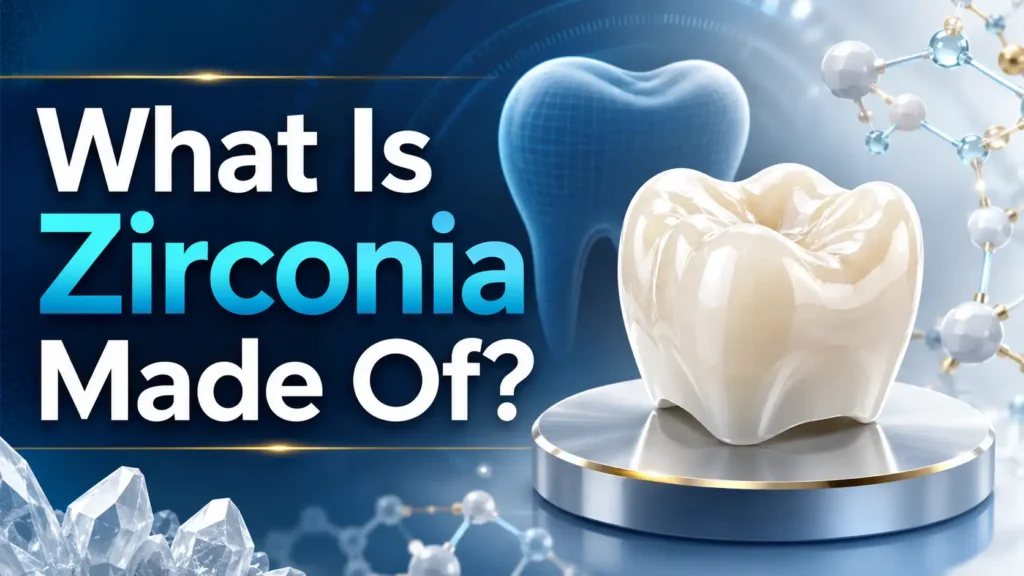
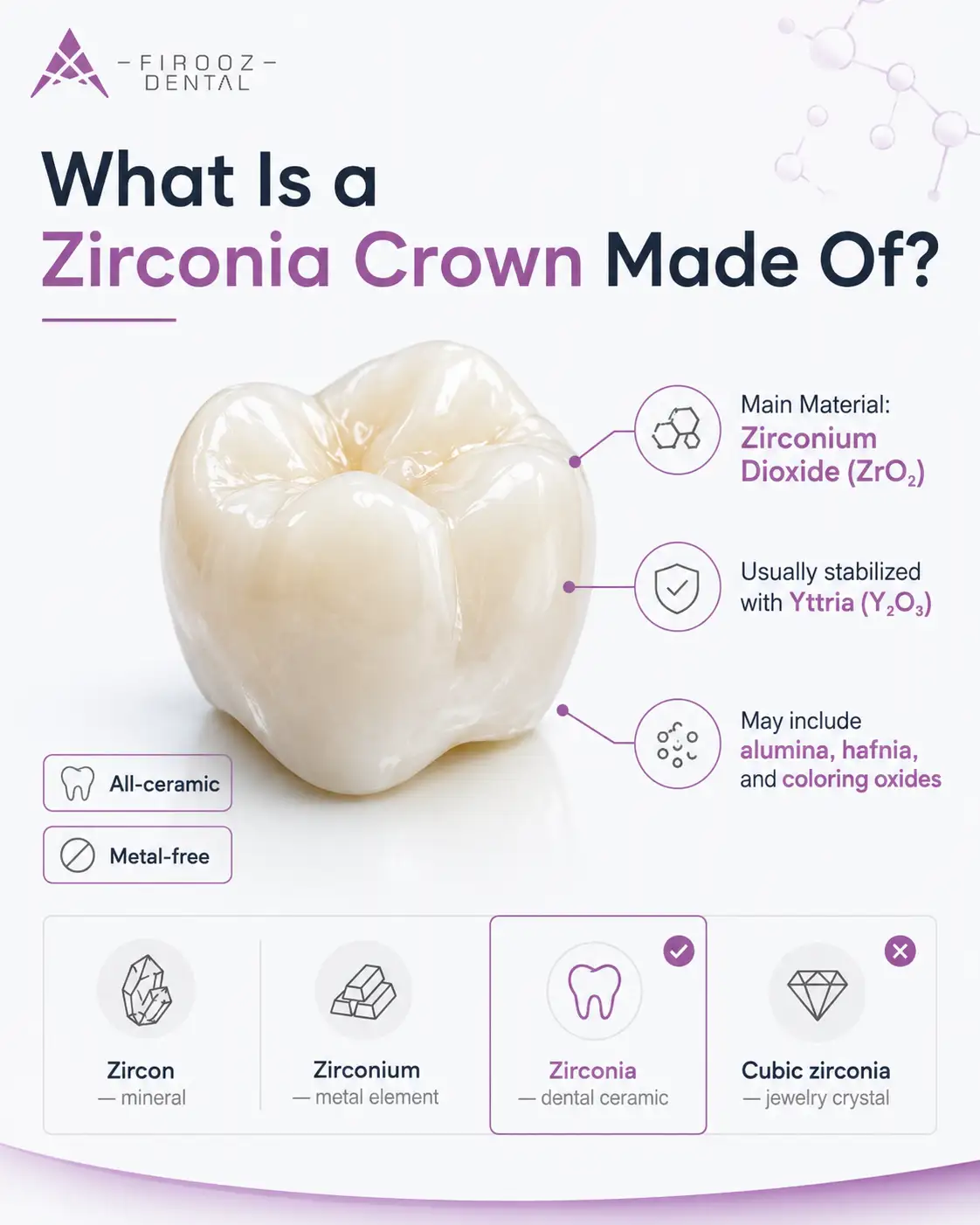
A zirconia crown, bridge, or other milled dental restoration starts with zirconium dioxide (ZrO₂). In modern CAD/CAM dentistry, zirconia powder is processed into industrially manufactured discs or blocks with a controlled composition and microstructure.
Most restorative dental zirconias are stabilized with yttrium oxide, or yttria (Y₂O₃). The stabilizer helps maintain crystal structures that provide the combination of mechanical and optical properties required for dental use.
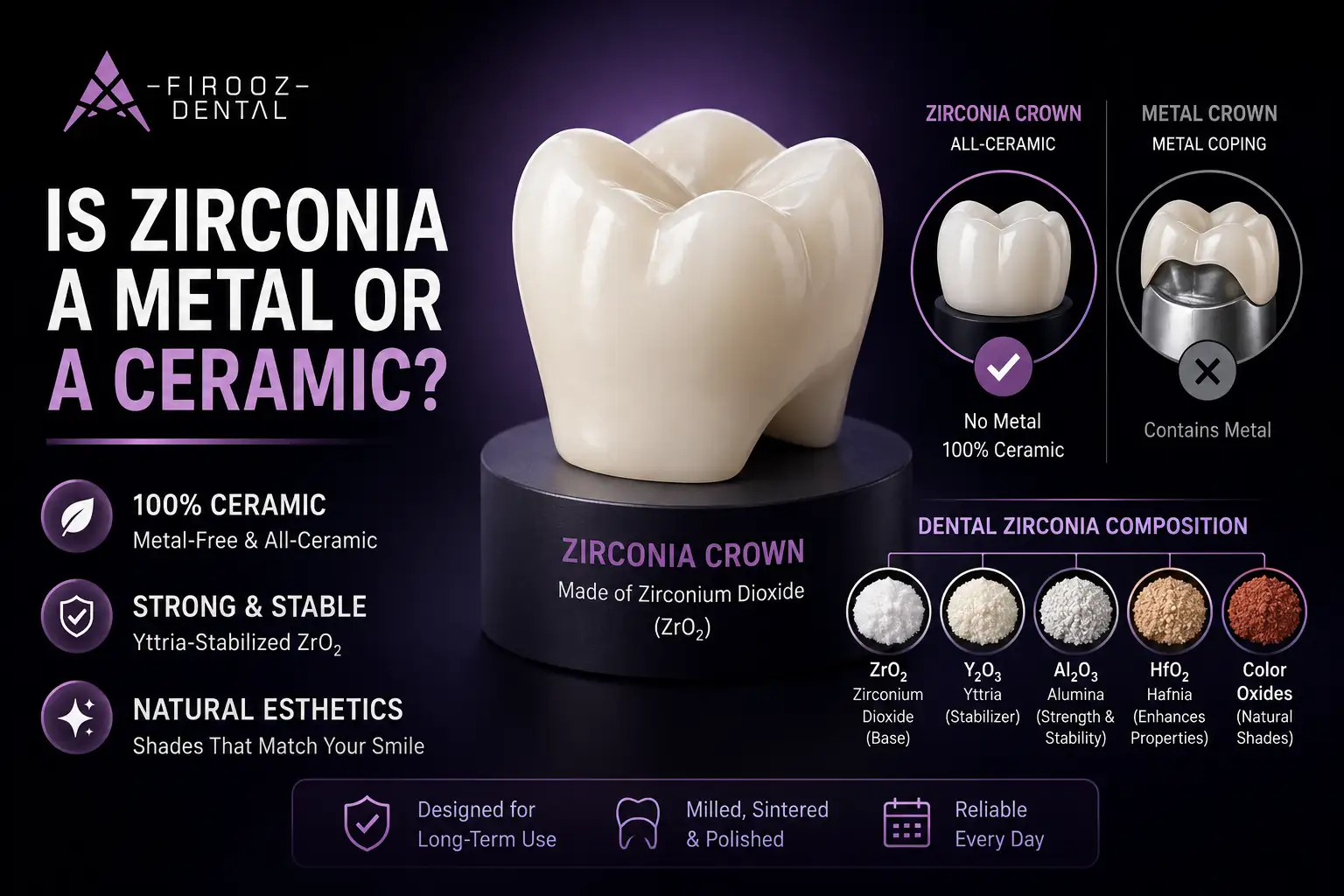
The exact formulation is product-specific. Depending on the zirconia system, the material may also contain small amounts of alumina and other oxides used to modify processing, color, aging behavior, or optical properties. A laboratory should therefore not assume that the formulation of one zirconia disc applies to every 3Y, 4Y, 5Y, multilayer, high-strength, or high-translucency material.
As one manufacturer-specific example, Aidite reports approximately 90–95% ZrO₂, 4–10% Y₂O₃, up to 0.5% Al₂O₃, and less than 0.5% other oxides for its 3D Pro Zir product family.[1] These values describe that specific product family and should not be treated as a universal chemical formula for all dental zirconias.
For clinics and laboratories comparing materials, the practical rule is simple: use the current technical data sheet, Instructions for Use (IFU), and processing documentation for the exact zirconia product as the source of truth.
Zirconium vs Zirconia: Is Zirconia a Metal or a Ceramic?
Zirconium and zirconia are related, but they are not the same material. Zirconium is the chemical element Zr and is classified as a metal. Zirconia is zirconium dioxide, ZrO₂, which is an oxide ceramic.
| Term | What it is | Relevance to a dental lab or clinic |
|---|---|---|
| Zircon | A naturally occurring zirconium silicate mineral | A mineral associated with the raw-material supply chain; not the restorative ceramic itself |
| Zirconium | A chemical element and metal | The element present in zirconium dioxide, but not equivalent to a zirconia restoration |
| Zirconia | Zirconium dioxide, ZrO₂ | The oxide ceramic used in dental discs, blocks, crowns, bridges, abutments, and other restorations |
| Cubic zirconia | A synthetic crystalline material commonly associated with jewelry | Should not be confused with restorative dental zirconia |
Therefore, when a restoration is described as all-ceramic zirconia, this refers to the final zirconium-dioxide ceramic structure. It does not mean that the restoration is fabricated from zirconium metal.
Why Is Yttria Added to Dental Zirconia?
Zirconia is a polymorphic ceramic, meaning its crystal structure can change depending on temperature, composition, and processing. Adding yttria allows manufacturers to stabilize zirconia structures that provide useful mechanical and optical properties at room temperature and under dental-service conditions.
In conventional 3Y-TZP, a relatively high proportion of transformable tetragonal zirconia contributes to a mechanism known as transformation toughening. When stress develops around a crack, part of the tetragonal structure can transform locally in a way that can oppose further crack propagation.
This is one reason conventional 3Y zirconia is associated with high fracture toughness compared with many more translucent zirconia formulations.
As yttria concentration increases, the material’s phase balance, transformability, grain structure, translucency, and mechanical behavior also change.
A common simplified explanation is:
Higher yttria concentration → greater translucency potential → different transformation behavior and mechanical properties.
However, this should not be reduced to a simple “more cubic phase equals more translucency” rule. Detailed crystallographic research on modern dental zirconias has identified yttria-lean and yttria-rich tetragonal phases, often described as t and t′ phases, and has challenged overly simple descriptions of these materials as mixtures of only tetragonal and cubic zirconia.[2]
For a dental laboratory, the practical takeaway is more important than the phase label itself: changing yttria content changes the balance among translucency, transformation-related toughening, and mechanical behavior.
3Y, 4Y, and 5Y Zirconia: What Changes for a Dental Lab?
The labels 3Y, 4Y, and 5Y generally refer to the approximate molar concentration of yttria used to stabilize zirconia. These categories are useful for understanding material families, but the label alone is not enough to select a dental zirconia disc.
Grain size, powder processing, multilayer design, pigmentation, sintering parameters, restoration thickness, connector design, and manufacturer-specific formulation also influence performance.
| Zirconia family | Approximate yttria level | General material tendency | Relative translucency | Relative mechanical behavior | Lab implication |
|---|---|---|---|---|---|
| 3Y-TZP | About 3 mol% Y₂O₃ | Greater contribution from transformable tetragonal zirconia | Generally lower | Generally higher fracture-toughness and strength potential | Often considered where mechanical demand is a primary selection factor |
| 4Y-PSZ | About 4 mol% Y₂O₃ | Intermediate optical and mechanical behavior | Generally higher than conventional 3Y | Typically between conventional 3Y and 5Y systems, depending on product | Often selected when esthetics and mechanical performance both matter |
| 5Y-PSZ | About 5 mol% Y₂O₃ | Higher-yttria and less transformation-toughened behavior | Generally higher | Generally lower fracture-toughness and flexural-strength potential than conventional 3Y | Often considered for more esthetically demanding indications when permitted by the manufacturer |
Direct laboratory research comparing 3Y-, 4Y-, and 5Y-based zirconia materials has demonstrated meaningful differences in translucency, biaxial flexural strength, and fracture toughness.[3]
These remain material-family trends rather than universal specifications. Two materials carrying the same 4Y or 5Y designation can still behave differently because of manufacturing, microstructure, pigmentation, multilayer architecture, and sintering protocol.
Before selecting a material, a laboratory should verify its stated indications, minimum wall thickness, connector requirements, mechanical-property data, compatible sintering program, and any restrictions on bridges or other multi-unit restorations.
How Strong Is Dental Zirconia?
“How strong is zirconia?” does not have one scientifically useful number. Flexural strength, fracture toughness, fatigue behavior, and fracture load measure different aspects of material or restoration performance.
A value reported for one product, specimen geometry, test standard, thickness, surface condition, or sintering cycle should not automatically be transferred to another zirconia system.
Flexural Strength
Flexural strength measures the stress a test specimen can resist before fracture under a defined bending configuration. It can help compare materials tested under similar conditions, but it does not directly predict the clinical lifetime of every crown or bridge.
Fracture Toughness
Fracture toughness describes resistance to crack propagation. This is different from flexural strength and is particularly relevant to zirconia because transformation-toughening behavior can contribute to crack resistance in suitable zirconia systems.
A material with a high flexural-strength value does not automatically have the same fracture-toughness profile as another material reporting a similar flexural-strength number.
Fatigue Behavior
Dental restorations experience repeated loading rather than a single laboratory fracture event. Research comparing 3Y-, 4Y-, and 5Y-based ceramics has also identified differences in fatigue behavior among zirconia grades.[4]
Restoration Geometry and Processing Still Matter
The final restoration is a structure, not a laboratory test bar. Connector cross-section, restoration thickness, span length, surface defects, bur condition, CAM strategy, sintering accuracy, occlusal design, and final polishing can all influence fracture behavior.
For this reason, laboratories should use product-specific values and indication limits rather than generic statements such as “all zirconia is 1,200 MPa” or “5Y is always weak.”
Is Dental Zirconia Safe and Biocompatible?
Zirconia has a substantial history of use in restorative and implant dentistry. However, biocompatibility and safety claims should still be tied to the specific material, intended use, processing conditions, and available product documentation.
For a clinic or laboratory, the current manufacturer IFU, intended indications, processing instructions, Safety Data Sheet where applicable, and relevant regulatory documentation remain the most important references for product-specific use.
In other words, the statement “zirconia is biocompatible” should not be interpreted as permission to treat every zirconia product, surface condition, indication, or processing workflow as interchangeable.
Surface Condition and Opposing Enamel
Surface finishing is an important part of zirconia performance. In laboratory studies, the surface condition of zirconia has influenced wear against opposing enamel.
One widely cited experimental study found that polished zirconia produced less opposing enamel wear than glazed or polished-then-reglazed zirconia under the tested conditions.[5]
This does not mean that one universal polishing protocol applies to every product. After laboratory or chairside adjustment, the finishing and polishing procedure recommended for the specific zirconia system should be followed.
Do Not Generalize Product-Specific Safety Claims
If a manufacturer provides chemical-solubility data, biocompatibility documentation, an SDS, IFU, or indication-specific certification, those records should be associated with the exact material used by the laboratory.
Composition or safety statements should not be copied from another brand simply because both products are described as “dental zirconia.”
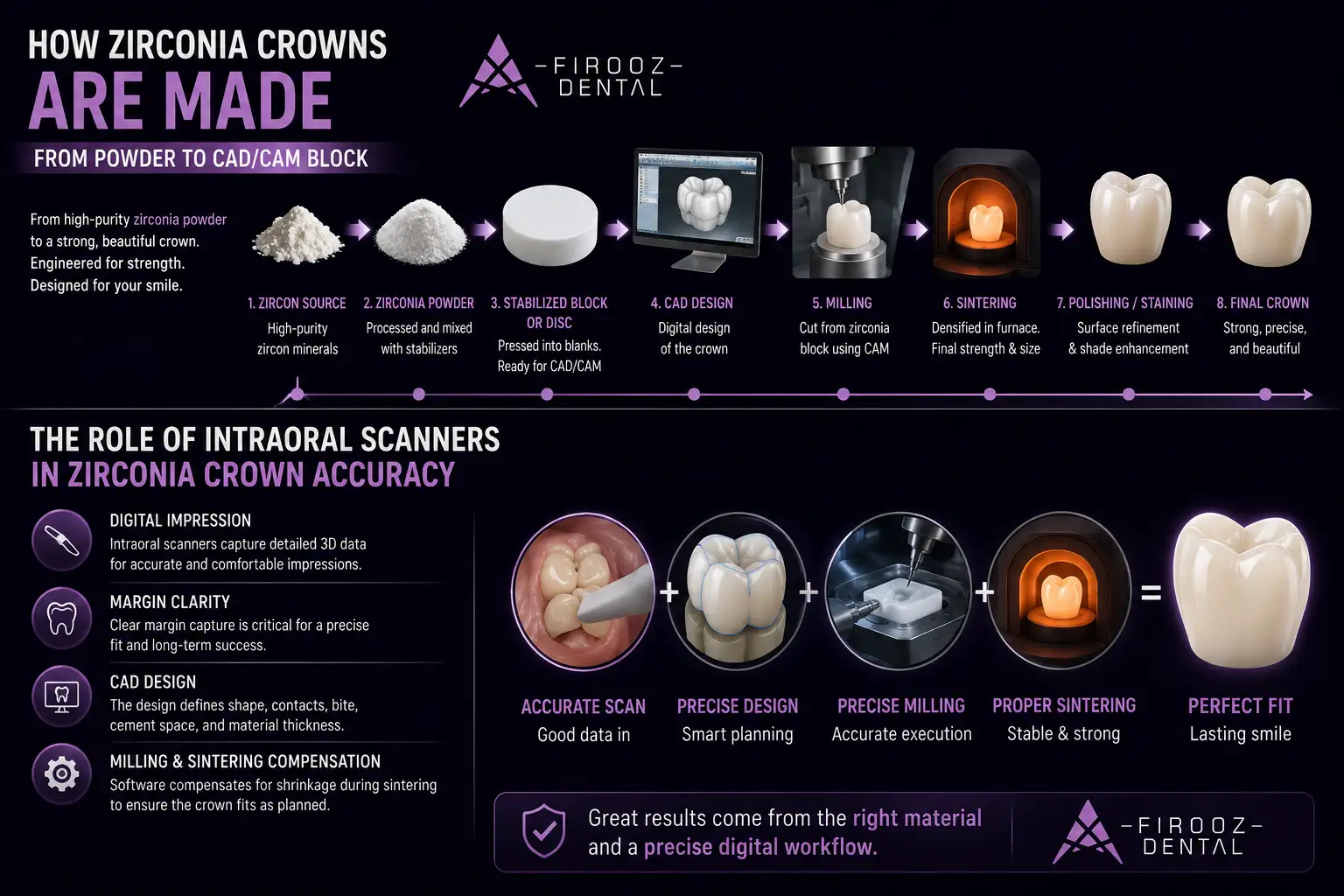
How Are Zirconia Crowns Made? From Dental Disc to Final Restoration
For a clinic or laboratory, the most useful way to understand zirconia composition is to connect the material to the actual CAD/CAM production workflow.
- Industrial powder preparation: zirconium dioxide powder is formulated with yttria and other manufacturer-specific constituents.
- Disc or block production: the powder is consolidated into a controlled blank, commonly supplied in a pre-sintered state for subtractive CAD/CAM manufacturing.
- CAD design and nesting: the restoration is designed, positioned in the zirconia disc, and assigned the correct material and shrinkage data in the CAM workflow.
- Milling: the enlarged pre-sintered restoration is machined with a compatible milling strategy, tools, holder, and material parameters.
- Post-milling preparation: supports are removed and the restoration is cleaned and prepared according to the zirconia manufacturer’s instructions.
- Sintering: the restoration is processed with the manufacturer-approved heating, holding, and cooling program. Densification produces the intended final dimensions and material structure.
- Finishing and quality control: fit verification, surface inspection, staining, glazing, polishing, and other final procedures are completed according to the restoration and material system.
The simplified workflow is:
ZrO₂-based formulation → pre-sintered zirconia disc/block → CAD design → CAM nesting → milling → sintering → finishing/polishing → quality control → final restoration
Why Milling Matters for Zirconia
Zirconia is commonly milled before final sintering because the pre-sintered blank is substantially easier to machine than fully densified zirconia. The CAM system must use the correct material profile and dimensional compensation supplied for the disc.
Bur condition, tool path, material positioning, support design, contamination control, holder compatibility, and machine calibration can influence chipping, marginal quality, surface defects, and final fit.
A laboratory changing from one zirconia system to another should therefore verify that its mill, holder, burs, CAM strategy, and material profile are appropriate for the new disc.
For available CAD/CAM systems, review dental milling machines used in dental laboratory production.
Why Sintering Matters for Zirconia
Sintering is not simply a final heating step. It is the stage in which the milled pre-sintered zirconia densifies and reaches its intended final dimensions and microstructure.
The selected temperature, heating rate, holding time, cooling program, furnace behavior, restoration size, and zirconia formulation can influence the result.
Experimental research comparing sintering conditions in 3Y-, 4Y-, and 5Y-based zirconia demonstrated changes in grain size and, depending on the zirconia grade, changes in translucency and low-temperature degradation behavior.[6]
A laboratory should therefore not copy a sintering cycle from another zirconia brand or assume that all “fast sintering” programs are interchangeable.
For example, Aidite publishes both conventional and faster sintering information for its 3D Pro Zir family and defines which restoration configurations can use the faster protocol.[1] This illustrates an important workflow principle: the sintering cycle belongs to the material system, not simply to the word “zirconia.”
Labs evaluating their production workflow can review dental sintering furnaces and compare furnace capability with the zirconia systems they intend to process.
What Should a Dental Lab Verify Before Choosing a Zirconia Disc?
| Attribute | What to verify | Preferred source |
|---|---|---|
| Material class | 3Y, 4Y, 5Y, multilayer, gradient, or other manufacturer-defined formulation | Manufacturer technical data / IFU |
| Composition | ZrO₂, Y₂O₃ and declared additional constituents | Manufacturer technical data / SDS |
| Indications | Single units, bridges, span limits, implant or other permitted applications | Current IFU |
| Mechanical data | Flexural strength, fracture toughness, test method and test conditions | Manufacturer + primary research |
| Optical behavior | Translucency, shade system, multilayer or gradient architecture | Manufacturer + validated laboratory evaluation |
| Dimensions | Disc diameter, thickness, shade, shrinkage factor or encoded material data | Product label / CAM material file |
| Milling compatibility | Machine, holder, burs and validated milling strategy | Machine/material manufacturer |
| Sintering | Temperature, cycle duration, heating/cooling rates and fast-cycle eligibility | Material manufacturer |
| Finishing | Adjustment, polishing, staining and glazing protocol | Current IFU |
| Documentation | IFU, SDS, lot traceability and relevant quality/regulatory documentation | Manufacturer / supplier |
Choosing Dental Zirconia by Material Data, Not Marketing Labels
Terms such as high strength, high translucency, multilayer, anterior, universal, 3D, 4D, or premium can be useful product names or positioning labels, but they are not substitutes for technical specifications.
Two discs using similar marketing terminology can have different yttria profiles, indication limits, sintering requirements, thickness recommendations, shade architecture, or mechanical properties.
For purchasing and production decisions, compare the actual product data and available indications in the dental zirconia discs and materials category.
Final Takeaway
What is zirconia made of? Dental zirconia is an oxide ceramic based primarily on zirconium dioxide (ZrO₂), most commonly stabilized with yttria (Y₂O₃). Additional constituents and their concentrations depend on the specific material system.
The amount and distribution of yttria, powder processing, microstructure, pigmentation, multilayer architecture, and manufacturing process distinguish one zirconia product from another.
For a dental laboratory or clinic, composition is only the starting point. The final performance of a zirconia restoration depends on the complete workflow:
material selection → CAD/CAM design → milling → manufacturer-specific sintering → finishing → quality control.
The 3Y, 4Y, and 5Y labels are useful for understanding zirconia families, but they should never replace the current technical documentation for the exact disc being used. Strength, translucency, indications, shrinkage, milling compatibility, and sintering parameters should all be verified from traceable sources before a material is incorporated into a production workflow.
FAQs
What is zirconia made of in dental crowns?
Dental zirconia crowns are made from a zirconium-dioxide-based ceramic. Most modern dental zirconias are stabilized with yttria, while additional constituents such as alumina and other oxides may be present depending on the specific product. Exact percentages should be verified in the manufacturer’s technical documentation.
Is zirconia the same as zirconium?
No. Zirconium is a chemical element and metal. Zirconia is zirconium dioxide, ZrO₂, which is an oxide ceramic. A zirconia restoration is therefore a ceramic restoration rather than a crown made from zirconium metal.
Is zirconia a metal or a ceramic?
Zirconia is an oxide ceramic. Although zirconium itself is a metallic element, combining zirconium with oxygen forms zirconium dioxide, which has fundamentally different material properties.
What is the difference between 3Y, 4Y, and 5Y zirconia?
The numbers generally refer to approximate molar yttria concentrations. Conventional 3Y-TZP generally retains greater transformation-toughening capability and higher fracture-toughness potential, while 4Y- and 5Y-based zirconias generally provide greater translucency with different mechanical behavior. Product-specific specifications and indication limits still take priority over the family label.
How is a zirconia crown made in a dental lab?
A zirconia restoration is digitally designed and milled from a pre-sintered disc or block in an enlarged state. It is then sintered using the material manufacturer’s approved cycle before being finished, polished, and quality-checked. The CAM system must use the correct shrinkage compensation for the specific material.
Does zirconia shrink during sintering?
Yes. Pre-sintered zirconia densifies and undergoes substantial dimensional change during final sintering. The exact shrinkage factor is material- and batch-specific and should be obtained from the product’s manufacturing data rather than estimated manually.
Does sintering change zirconia?
Yes. Sintering establishes the final density and contributes to the material’s final microstructure. Sintering conditions can affect grain structure and other properties, which is why laboratories should use the cycle validated for the exact zirconia product.
Is 5Y zirconia always better because it is more translucent?
No. Greater translucency does not automatically make a zirconia material better for every restoration. Selection should consider indication, restoration design, span, thickness, mechanical requirements, esthetic requirements, and the manufacturer’s validated limits.
Can every zirconia disc use the same sintering cycle?
No. Sintering temperature, heating rate, holding time, cooling cycle, and fast-sintering eligibility can differ among zirconia products. Laboratories should follow the current manufacturer’s instructions for the specific disc being processed.
Technical Sources
- Aidite. 3D Pro Zir manufacturer brochure and technical documentation. Manufacturer-reported composition includes ZrO₂, Y₂O₃, Al₂O₃ and other oxides, together with product-specific sintering information.
- Nakamura K, Shishido S, Inagaki R, et al. Critical evaluations on the crystallographic properties of translucent dental zirconia ceramics stabilized with 3–6 mol% yttria. Dental Materials. 2024;40(9):1425–1451. DOI: 10.1016/j.dental.2024.06.027.
- Jerman E, Lümkemann N, Eichberger M, et al. Evaluation of translucency, Martens hardness, biaxial flexural strength and fracture toughness of 3Y-TZP, 4Y-TZP and 5Y-TZP materials. Dental Materials. 2021;37(2):212–222. DOI: 10.1016/j.dental.2020.11.007.
- Jerman E, Lümkemann N, Eichberger M, Hampe R, Stawarczyk B. Impact of varying step-stress protocols on the fatigue behavior of 3Y-TZP, 4Y-TZP and 5Y-TZP ceramic. Dental Materials. 2021;37(7):1073–1082. DOI: 10.1016/j.dental.2021.03.013.
- Janyavula S, Lawson N, Cakir D, Beck P, Ramp LC, Burgess JO. The wear of polished and glazed zirconia against enamel. Journal of Prosthetic Dentistry. 2013;109(1):22–29. DOI: 10.1016/S0022-3913(13)60005-0.
- Too TDC, Inokoshi M, Nozaki K, et al. Influence of sintering conditions on translucency, biaxial flexural strength, microstructure, and low-temperature degradation of highly translucent dental zirconia. Dental Materials Journal. 2021;40(6):1320–1328. DOI: 10.4012/dmj.2020-448.