
When comparing intraoral scanner vs impression, the real question is not which method is “better” in every case, but which one gives the dentist the most accurate result with the least stress for the patient and the clinic. Intraoral scanners are often the better choice for comfort, speed, single crowns, many short-span restorations, orthodontic records, and fast lab communication. Traditional impressions still matter when margins are deep, moisture control is poor, access is limited, or a full-arch case needs extra caution.
here is an audio version of the article:
The best answer to intraoral scanner vs traditional impression is practical: use digital scanning when the field is visible and the workflow supports it; use conventional impressions when the clinical situation makes optical capture less predictable.
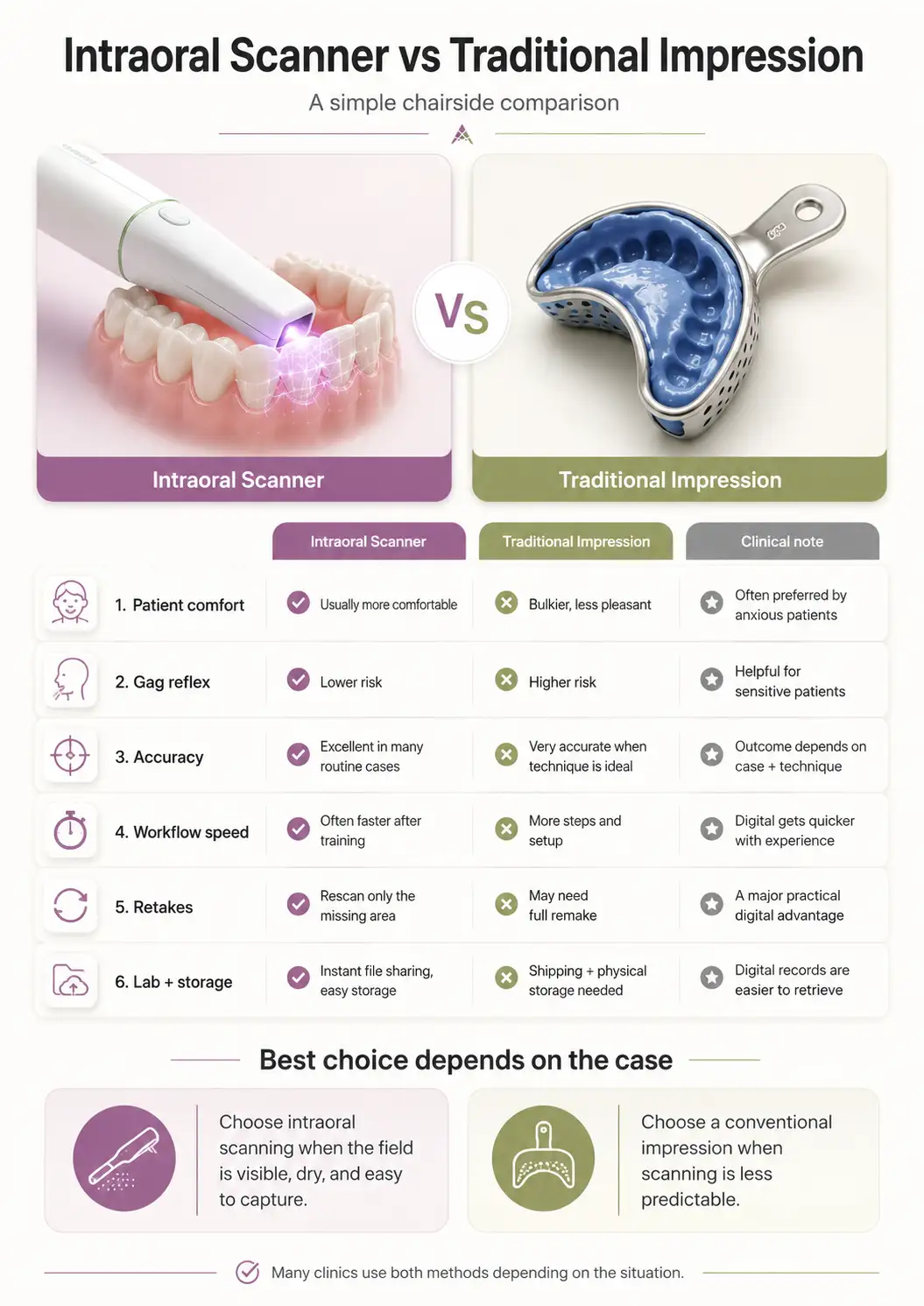
Intraoral Scanner vs Traditional Impression: Side-by-Side Comparison
A clear comparison of intraoral scanner vs traditional impression should go beyond the simple idea of “digital scan vs dental mold.” Both methods are used to capture the shape of teeth, soft tissue, bite relationship, and prepared areas for restorations or appliances. The difference is how they collect that information, how the dentist checks it, and how the lab receives it.
An intraoral scanner captures the mouth optically and creates a digital model. A traditional impression uses an impression tray and physical material, such as alginate, PVS impression material, or polyether, to create a negative copy of the mouth. From that copy, the lab may pour a gypsum cast or scan the model later.
The table below gives a practical chairside comparison.
| Factor | Intraoral Scanner | Traditional Impression | Clinical Note |
| Patient comfort | Usually more comfortable because no full tray of material is kept in the mouth | Can feel bulky, unpleasant, or stressful for some patients | Digital scanning is often preferred for patients with anxiety or sensitivity |
| Gag reflex | Lower risk because the scanner tip is smaller than a full impression tray | Higher risk, especially with maxillary impressions or heavy material | For strong gag reflex patients, scanning can make the visit easier |
| Accuracy | Strong for many crowns, short-span restorations, aligners, and records when the field is dry and visible | Can be very accurate when material handling, tray fit, and timing are correct | Neither method is perfect; accuracy depends on case type and technique |
| Chair time | Often shorter after the team learns the scan path | Can take longer due to tray selection, mixing, setting, removal, and possible retakes | The first digital scans may take longer during the learning phase |
| Retake process | A missed area can often be rescanned locally | A defect may require repeating the entire impression | This is one of the biggest practical gains of digital scanning |
| Lab communication | File can be sent directly to the lab or CAD/CAM system | Physical impression or model must be shipped or poured first | Digital files can shorten back-and-forth communication |
| Storage | Digital case files reduce the need for physical storage | Physical impressions and stone models need space and handling | Digital records are easier to retrieve, copy, and share |
| Material cost | Less recurring material use, but device and software costs apply | Lower starting cost, but ongoing material, tray, shipping, and model costs continue | Cost should be judged per month or per case, not only by purchase price |
| Upfront cost | High; scanner, software, training, and support must be considered | Low; most clinics already have the tools and materials | Scanner purchase makes more sense when case volume supports it |
| Learning curve | Requires scan strategy, margin reading, software use, and file export knowledge | Familiar to most dentists and assistants | A scanner is only as good as the person using it |
| Best use cases | Single crowns, short-span restorations, aligners, implant crowns with scan bodies, night guards, records, patient communication | Deep margins, poor moisture control, some full-arch cases, limited access, cases where optical capture is difficult | Many clinics use both methods depending on the case |
| Main limitations | Saliva, blood, shiny surfaces, deep margins, scan stitching errors, long-span distortion | Material distortion, bubbles, tearing, tray movement, pouring errors, shipping damage | Both methods can fail if the field and technique are poor |
The best clinical answer is not that one method replaces the other in every situation. A more useful answer is this: use an intraoral scanner when the area is visible, dry, and suitable for optical capture; use a conventional impression when the clinical field makes scanning less predictable.
Decision Guide: Which Method Should You Choose?
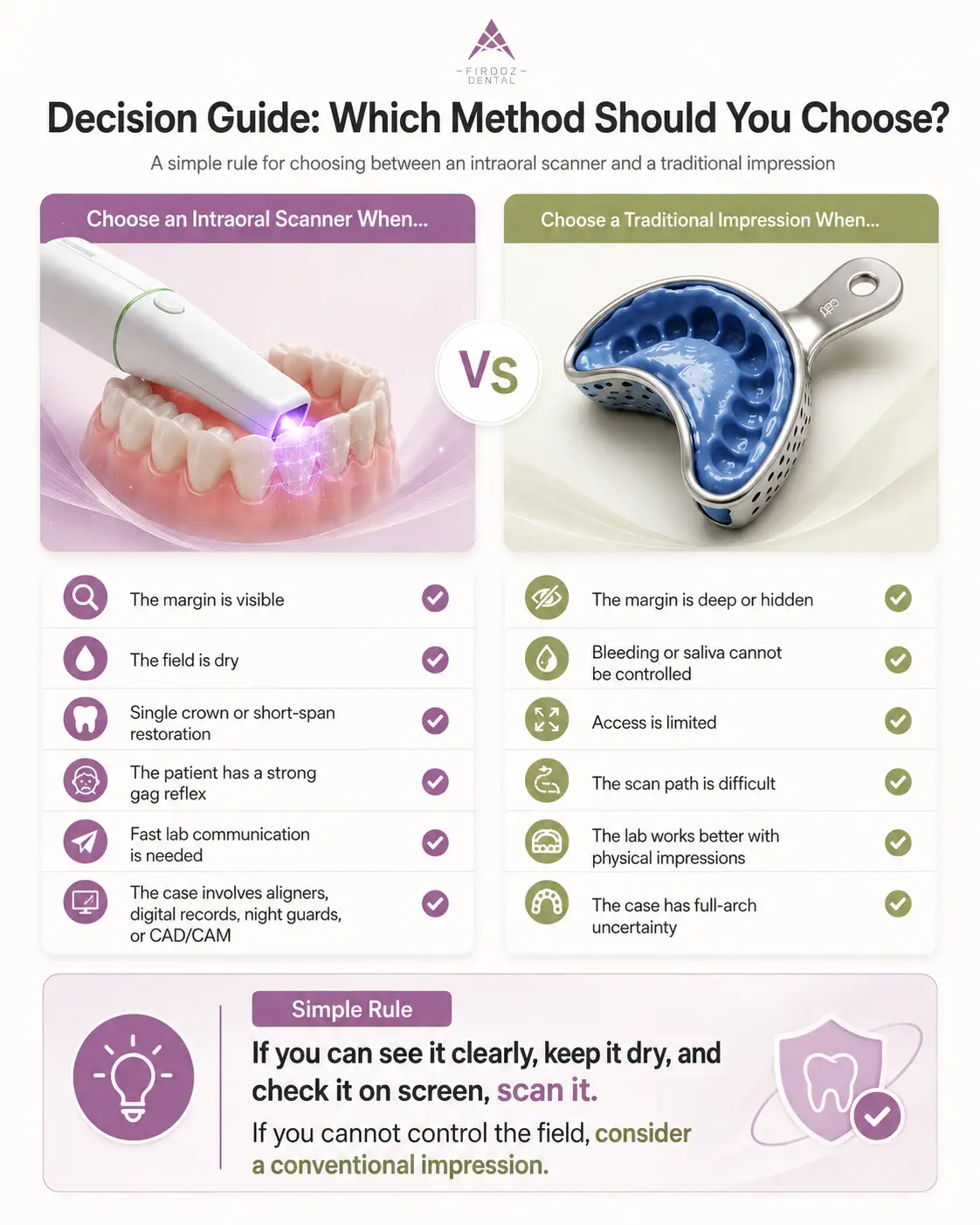
The best method depends on the case. Use this simple guide:
| Choose an Intraoral Scanner When… | Choose a Traditional Impression When… |
| The margin is visible | The margin is deep or hidden |
| The field is dry | Bleeding or saliva cannot be controlled |
| The case is a single crown or short-span restoration | Access is limited |
| The patient has a strong gag reflex | The scan path is difficult |
| The clinic needs fast lab communication | The lab works better with physical impressions |
| The case involves aligners, digital records, night guards, or CAD/CAM work | The case has full-arch uncertainty |
A simple rule for intraoral scanner vs impression is this: if you can see it clearly, keep it dry, and check it on screen, scan it. If you cannot control the field, consider a conventional impression.
What Is an Intraoral Scanner?
An intraoral scanner is a digital dental device that captures the mouth with optical imaging and builds a three-dimensional model on screen. Instead of filling a tray with impression material, the dentist moves a small scanner tip over the teeth, gingiva, preparation margins, bite surfaces, or scan bodies. The software joins those images into a digital model that can be checked before the patient leaves the chair.
In daily practice, this matters because the dentist can see the impression immediately. If a margin is missing, a contact area is unclear, or part of the bite was not captured, the clinician can correct that part at once. With a traditional impression, many problems may not become obvious until the impression is removed, disinfected, poured, scanned by the lab, or reviewed later.
A digital impression can be used for many treatments, including:
- Crowns and bridges
- Implant restorations
- Clear aligners
- Night guards
- Smile design
- Diagnostic records
- Patient monitoring
- Lab communication
- CAD/CAM dentistry
A simple digital workflow often looks like this:
Scan → Review → Rescan missing areas → Send to lab or CAD/CAM software → Design → Fabricate
The output is usually a digital file. The most common file type is STL file, which stores the surface shape of the scan. Some systems may also use PLY or OBJ files. In simple terms, STL is like the digital shape of the teeth, while PLY and OBJ can also carry color or surface detail depending on the system. For many labs, the key point is whether the scanner can export files in a format they can use.
This is why an intraoral scanner is not just a replacement for impression material. It changes how the dentist checks the case, how fast the lab receives it, how the design starts, and how easily the file can be stored or shared.
What Is a Traditional Dental Impression?
A traditional dental impression uses an impression tray and a physical material to capture the shape of the teeth and surrounding tissues. The patient bites or holds the material in place until it sets. The result is a negative copy of the mouth. From that impression, the lab can create a gypsum cast, scan the model, or use it to fabricate a restoration or appliance.
Traditional impressions are still widely used because they are familiar, accessible, and cost less to start. Many dentists have years of experience with them, and many labs still work very well with physical impressions. In some cases, a conventional impression can also be the safer choice, especially when the scanner cannot clearly capture a deep margin, a wet field, or a narrow area.
Common impression materials include:
| Material | Common Use | Strength | Limitation |
| Alginate | Study models, orthodontic records, temporary appliances | Low cost and easy to use | Less stable over time and not ideal for high-detail final restorations |
| PVS impression material | Crowns, bridges, implants, final impressions | Good detail capture and dimensional stability | Technique-sensitive; bubbles, pulls, or tray movement can affect the result |
| Polyether | Fixed prosthodontics and implant impressions | Good flow and detail capture | Can feel rigid and may be uncomfortable for some patients |
| Impression compound or specialty materials | Border molding, edentulous cases, selected prosthetic uses | Useful in certain removable prosthodontic workflows | More technique-dependent and less common in routine crown cases |
The main weakness of traditional impressions is that the dentist cannot inspect the result digitally in real time. A void, drag mark, missed margin, or distortion may require a full retake. The process also involves more physical steps: tray selection, material mixing, setting time, removal, disinfection, shipping, pouring, trimming, and storage.
Still, conventional impressions remain useful. They are not just an “old” method. In the right hands and in the right case, they can produce excellent results. The practical choice between intraoral scanner vs impression should come from the clinical field in front of the dentist: Can the area be seen clearly? Can it be kept dry? Is the margin readable? Is the case short-span or full-arch? Does the lab accept digital files? Once those questions are answered, the better method is usually clear.
Accuracy: Is an Intraoral Scanner More Accurate Than an Impression?
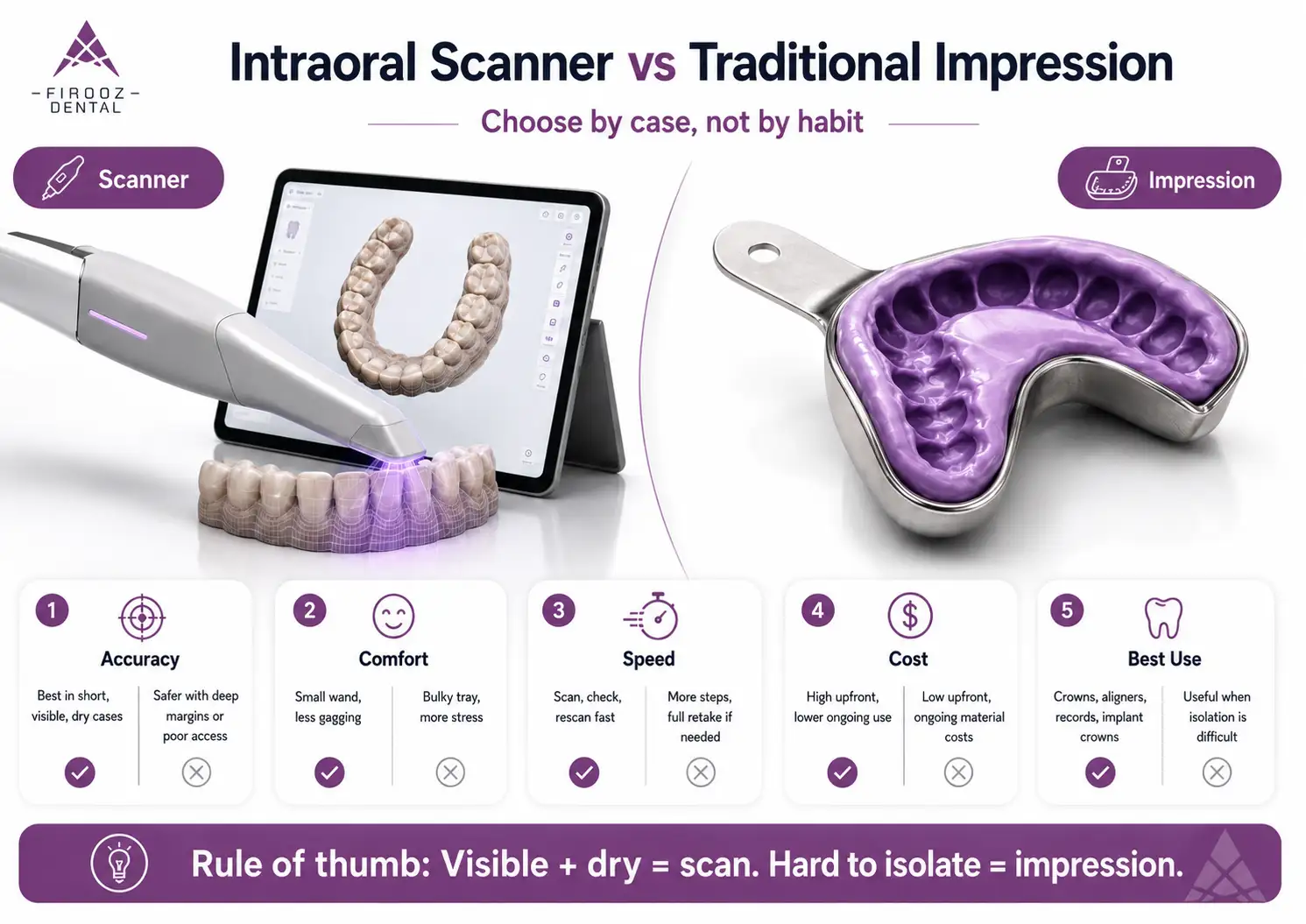
Accuracy in intraoral scanner vs impression comparisons depends on the case, not on the method alone. A digital scan can work very well for single crowns, short-span restorations, aligners, and many implant crown cases when the field is dry, the margin is visible, and the scan path is controlled. Traditional impressions can also produce excellent results when the tray fits well, the material is handled correctly, and the impression is removed without distortion. The key difference is the type of error each method can create: intraoral scanners may face problems with saliva, blood, shiny surfaces, missed margins, long scan paths, and stitching errors, while conventional impressions may fail because of bubbles, tray movement, tearing, material distortion, or stone model errors. In simple terms, digital scanning is often very strong in short, visible, well-isolated cases, while traditional impressions may still be safer when access is poor, margins are deep, or the field cannot be kept clean and dry.
Patient Comfort: Scanner Wand vs Impression Tray
Patient comfort is one of the clearest differences in intraoral scanner vs traditional impression cases. An intraoral scanner uses a small wand to capture the teeth and soft tissue, so the patient does not need to hold a large tray full of impression material in the mouth until it sets. This matters a lot for patients with gag reflex, dental anxiety, breathing difficulty, nausea, or a bad past experience with impressions. Traditional impressions can still be done successfully, but they may feel bulky, messy, and stressful for sensitive patients, especially during upper arch impressions or posterior cases. With digital scanning, the dentist can pause, remove the scanner tip, continue in sections, and rescan only a missing area if needed, which usually gives the patient more control and makes the appointment easier for the dental team too.
Workflow Speed
The time advantage of a digital workflow is not only about how fast the scan is taken; it is about reducing the number of steps between the patient’s mouth and the lab. In a traditional workflow, the dentist selects a tray, mixes or dispenses material, waits for setting, removes the impression, checks it, disinfects it, sends it to the lab or pours a model, and then waits for the lab to review the physical record. In a digital workflow, the dentist scans the mouth, checks the model on screen, fixes missing areas while the patient is still in the chair, exports the file, and sends it to the lab or CAD/CAM system. The biggest time saving often happens when an error is caught immediately: instead of repeating the full impression, the dentist can correct only the missing scan area and send a cleaner case to the lab sooner.
Cost Comparison
Cost is one of the main reasons clinics compare intraoral scanner vs impression before changing their routine. Traditional impressions have a lower starting cost because most clinics already have trays, materials, adhesives, and staff experience, but they still create ongoing costs through impression material, tray supplies, disinfection, shipping, model pouring, storage, retakes, and chair time. Intraoral scanners cost much more at the beginning because the clinic must pay for the device, training, software, support, maintenance, and sometimes subscription fees. The purchase makes more sense when the scanner is used often for crowns, aligners, implant crowns, night guards, records, patient communication, and lab files. For a clinic with enough case volume and a lab that accepts digital files, the scanner can reduce material use, remake risk, storage needs, and delays; for a clinic with low restorative volume or weak digital lab support, traditional impressions may remain more practical.
Clinical Use Cases
Intraoral scanners usually perform best when the target area is visible, dry, accessible, and not too long to scan without drift. They are especially useful for single crowns, short-span restorations, clear aligners, orthodontic records, night guards, implant crowns with well-seated scan bodies, diagnostic models, monitoring, and patient communication. In single crown cases, the dentist can check the margin and bite before the patient leaves; in aligner cases, the scan can replace repeated alginate impressions and make records easier to store and share; in implant crown cases, the scan body can help transfer implant position digitally if it is fully seated and clearly captured. Still, complex full-arch cases, deep subgingival margins, heavy bleeding, saliva control problems, narrow post spaces, and limited access may need extra caution or a traditional impression. The most practical approach is not to choose one method forever, but to choose the method that fits the patient, the preparation, the restoration, the lab, and the dentist’s skill.
When Traditional Impressions Still Make Sense
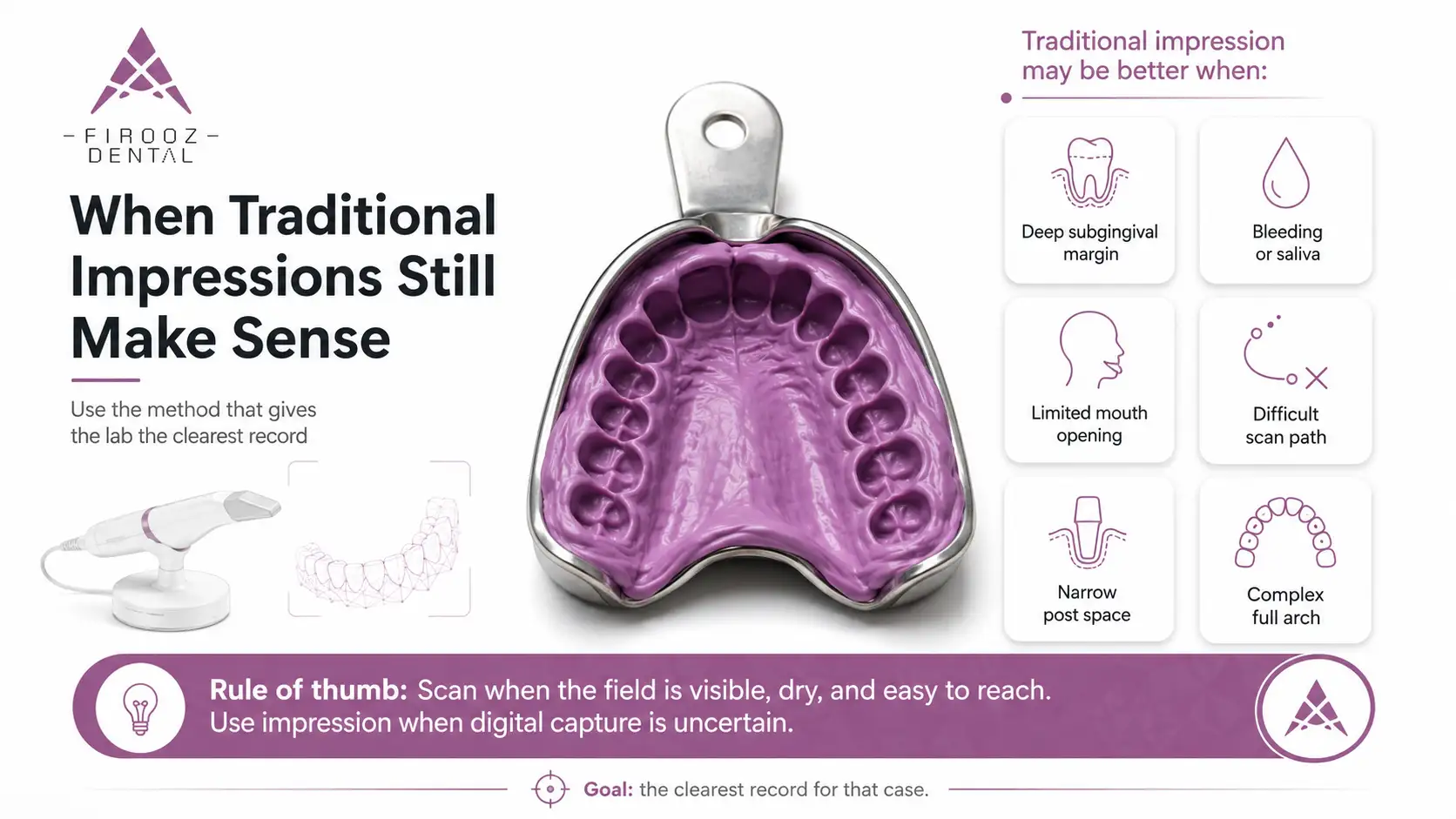
Traditional impressions still have a place in dentistry because an intraoral scanner can only record what it can clearly see. If the margin is hidden under the gum, covered with blood or saliva, or placed in an area with poor access, the digital scan may miss the exact detail the lab needs. In these cases, conventional materials such as PVS or polyether may still give the dentist a more usable record.
Traditional impressions may be the better choice when:
- The margin is deep under the gum
- Bleeding or saliva cannot be controlled
- The patient has limited mouth opening
- The scan path is difficult
- The case involves a narrow post space
- The full arch is too complex for a scan alone
The practical rule is simple: scan when the field is visible, dry, and easy to reach. Use a traditional impression when the clinical field makes digital capture uncertain. In intraoral scanner vs impression decisions, the goal is not to choose the newer method; the goal is to give the lab the clearest record for that case.
Full-Arch Scans
A full-arch scan is not just a longer version of a crown scan. It is harder because the scanner has to connect many small images across a wide area. The longer the scan path becomes, the more likely small errors can build up.
| Challenge | Why It Matters |
| Long scan path | Small errors may add up across the arch |
| Saliva or soft-tissue movement | The scanner may capture unstable surfaces |
| Few natural landmarks | Edentulous arches are harder to scan |
| Patient movement | The digital model may become less accurate |
| Scan body position | Implant cases depend on correct scan body capture |
| Scanner angle changes | The software may join images less accurately |
Digital full-arch cases can work well, but they need careful planning, a repeatable scan path, close review, and clear lab instructions. In edentulous arches and full-arch implant cases, the dentist should decide case by case whether digital scanning, traditional impression, or a mixed method is the safer choice.
Learning Curve (Why Operator Skill Matters)
A good scanner does not guarantee a good scan. The dentist and assistant still need to prepare the field, expose the margin, control saliva, follow the right scan path, and check the digital model before sending it to the lab.
A strong intraoral scanner training routine should cover:
- Margin capture
- Bite registration
- Scan path
- Rescanning missing areas
- File export
- Scanner calibration
- Lab feedback
- When to switch to a traditional impression
This is one of the most important points in intraoral scanner vs traditional impression comparisons. A trained team can save time with digital scanning. An untrained team may create more remakes, more lab questions, and more chairside stress. The scanner is only useful when the team knows how to use it well.
Digital File, Lab Communication, and CAD/CAM Use
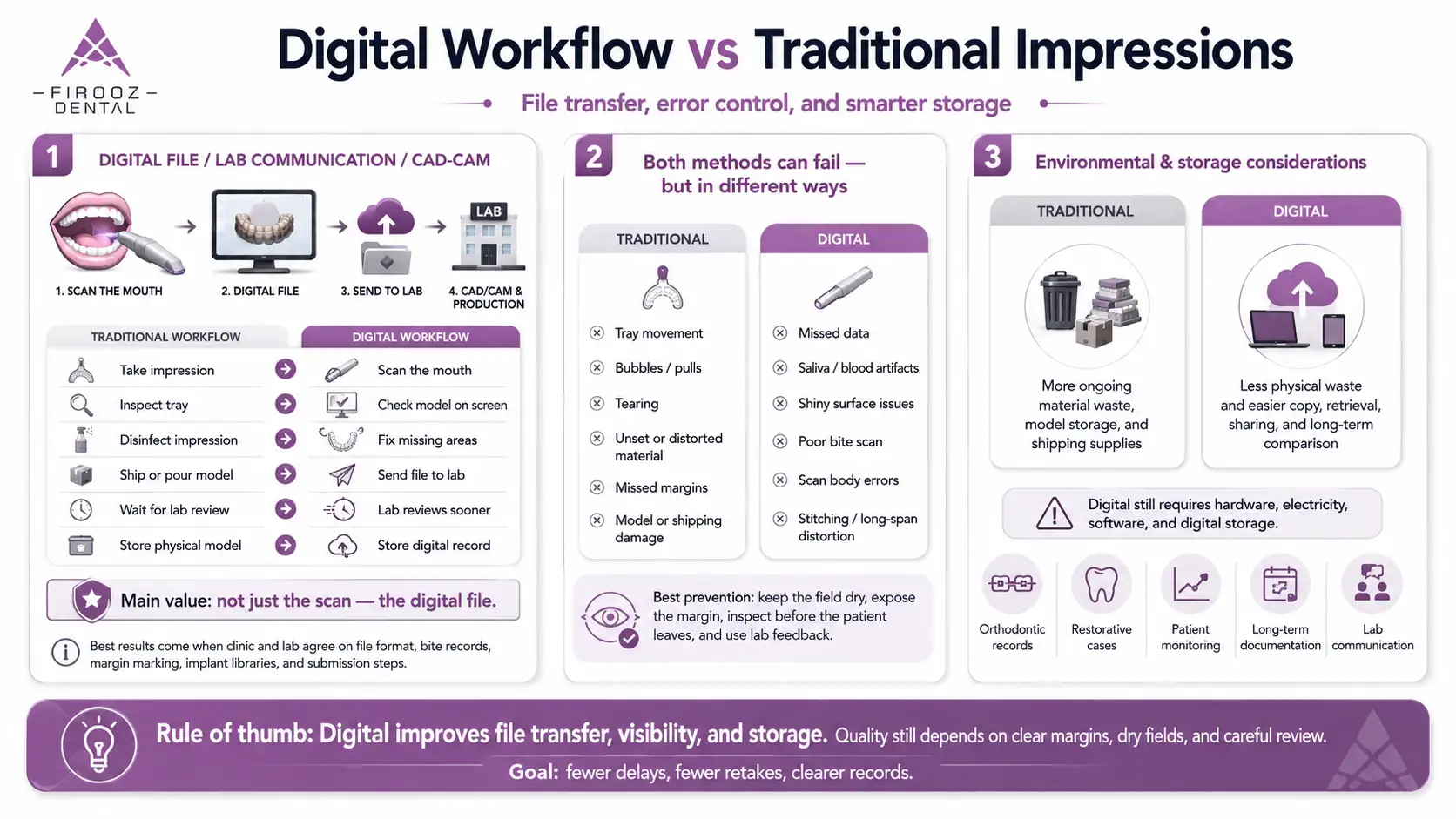
The main value of an intraoral scanner is not only the scan. It is the file that comes after the scan. Once the digital impression is captured, the dentist can check it on screen, correct missing areas, and send it to the lab or CAD/CAM system.
A digital workflow can remove several physical steps:
| Traditional Workflow | Digital Workflow |
| Take impression | Scan the mouth |
| Remove and inspect tray | Check the model on screen |
| Disinfect impression | Correct missing scan areas |
| Ship or pour model | Send file to lab |
| Wait for lab review | Lab reviews case sooner |
| Store physical model | Store digital record |
This can reduce delays, especially when the lab sees the case early and asks for changes before the patient is gone. The benefit is strongest when the clinic and lab agree on file format, bite records, margin marking, implant libraries, and case submission steps.
Common Errors in Both Methods
Both methods can fail. They simply fail in different ways.
| Method | Common Errors |
| Traditional impressions | Tray movement, bubbles, pulls, tearing, unset material, distortion, missed margins, model damage, shipping problems |
| Digital scans | Missed data, saliva artifacts, blood artifacts, shiny surface issues, poor bite scan, scan body errors, stitching errors, long-span distortion |
The best way to reduce retakes is to control the weak points of each method. Keep the field dry, expose the margin, check the impression before the patient leaves, and listen to lab feedback. Digital scanning has one clear chairside benefit: many errors can be seen on screen right away. Traditional impressions can also be excellent, but they need careful inspection before they leave the room.
Environmental and Storage Considerations
Digital impressions can reduce some physical waste. They may lower the use of impression material, trays, shipping supplies, stone models, and storage boxes. Digital records are also easier to copy, send, retrieve, and compare over time.
This is useful for:
- Orthodontic records
- Restorative cases
- Patient monitoring
- Long-term documentation
- Lab communication
Still, the environmental point should stay realistic. A scanner is a physical device. It uses electricity, may depend on online storage, and will need repair or replacement at some point. The fair comparison is this: traditional impressions create ongoing material waste and storage needs, while digital impressions reduce many physical items but add hardware, software, and digital storage responsibilities.
Practical Buying Considerations Before Replacing Traditional Impressions
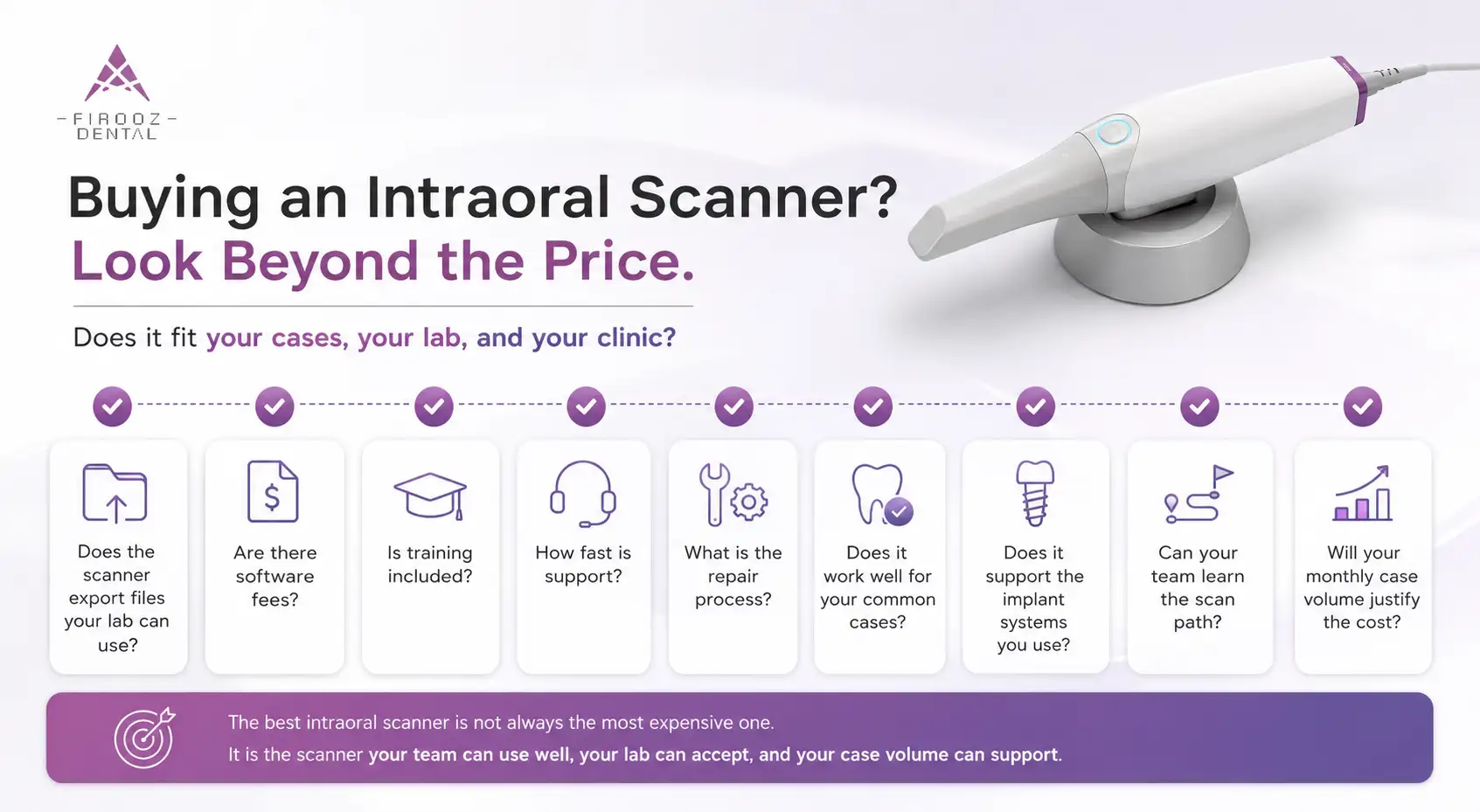
Before buying an intraoral scanner, a clinic should look beyond the price. The better question is: does this scanner fit the cases the clinic actually does?
Check these points before replacing traditional impressions:
- Does the scanner export files your lab can use?
- Are there software fees?
- Is training included?
- How fast is support?
- What is the repair process?
- Does it work well for your common cases?
- Does it support the implant systems you use?
- Can your team learn the scan path?
- Will your monthly case volume justify the cost?
The best intraoral scanner for dental practice is not always the most expensive one. It is the scanner your team can use well, your lab can accept, and your case volume can support.
Final Clinical Takeaway
The best way to compare intraoral scanner vs impression is to stop treating it as a fight between digital and traditional dentistry. Intraoral scanners are often better for comfort, speed, records, lab communication, and many routine restorative cases. Traditional impressions still matter when margins are hidden, moisture control is poor, access is limited, or the case needs a different capture method.
The right choice depends on:
- The patient
- The preparation
- The restoration
- The scan field
- The operator
- The lab
- The cost structure of the clinic
So, intraoral scanner vs traditional impression is not about choosing one method forever. It is about choosing the method that gives the safest and clearest record for that specific case.
FAQs
- Is an intraoral scanner better than a traditional impression?
Not always. An intraoral scanner is often better for comfort, speed, and digital lab communication, while traditional impressions may still be better when margins are deep or moisture control is difficult.
- Are digital impressions as accurate as traditional impressions?
Yes, in many cases such as single crowns, short-span restorations, aligners, and implant crowns. Accuracy depends on visibility, isolation, scan path, material handling, and the type of case.
- Do intraoral scanners reduce gag reflex?
Usually, yes. A scanner tip is much smaller than a full impression tray, so patients with gag reflex often tolerate digital scans more easily.
- When should a dentist still use a traditional impression?
Traditional impressions may be preferred for deep subgingival margins, heavy bleeding, poor saliva control, limited access, narrow post spaces, or complex full-arch cases.
- Are intraoral scanners good for crowns?
Yes. Intraoral scanners are commonly used for single crowns and short-span restorations, especially when the preparation margin is visible and dry.
- Are digital scans better for clear aligners?
Yes, digital scans are very useful for clear aligners because they create clean digital records that can be sent directly for treatment planning and appliance design.
- Do intraoral scanners save chair time?
They can, especially after the dental team learns the scan path. The biggest time saving often comes from checking the scan on screen and correcting small missing areas immediately.
- Are intraoral scanners expensive?
Yes, the starting cost is high because the clinic must pay for the scanner, software, training, support, and maintenance. The value depends on case volume and lab compatibility.
- Can digital impressions replace traditional impressions completely?
In many clinics, digital impressions can replace a large part of daily impression work, but not every case. A mixed approach is often the safest choice.
- What is the main difference between an intraoral scanner and a traditional impression?
An intraoral scanner captures the mouth optically and creates a digital file. A traditional impression uses physical material in a tray to create a mold that the lab uses or scans later.