Intraoral scanners are widely used in dental practices because they improve how impressions are captured, reviewed, and transferred in daily clinical work. They allow dentists to create accurate digital impressions for crowns, short-span restorations, orthodontic records, and many implant cases without impression trays or materials. The main benefits include more consistent results, better patient tolerance, immediate quality control, and faster communication with dental laboratories. For practices focused on restorative care, implants, or orthodontics, intraoral scanners can reduce remakes, shorten appointments, and support more predictable treatment outcomes when used in the right clinical situations.
Instead of reading the entire article, you can listen to the short podcast below:
What Is an Intraoral Scanner? An intraoral scanner is a handheld device that captures direct digital impressions of the teeth and surrounding oral structures using optical imaging. Instead of impression trays and materials, the scanner records a series of images that are processed into a three-dimensional model, which can be used for diagnosis, treatment planning, and laboratory communication within a digital dental workflow.
some uses of intraoral scanners are here:
Key Advantages of Intraoral Scanners
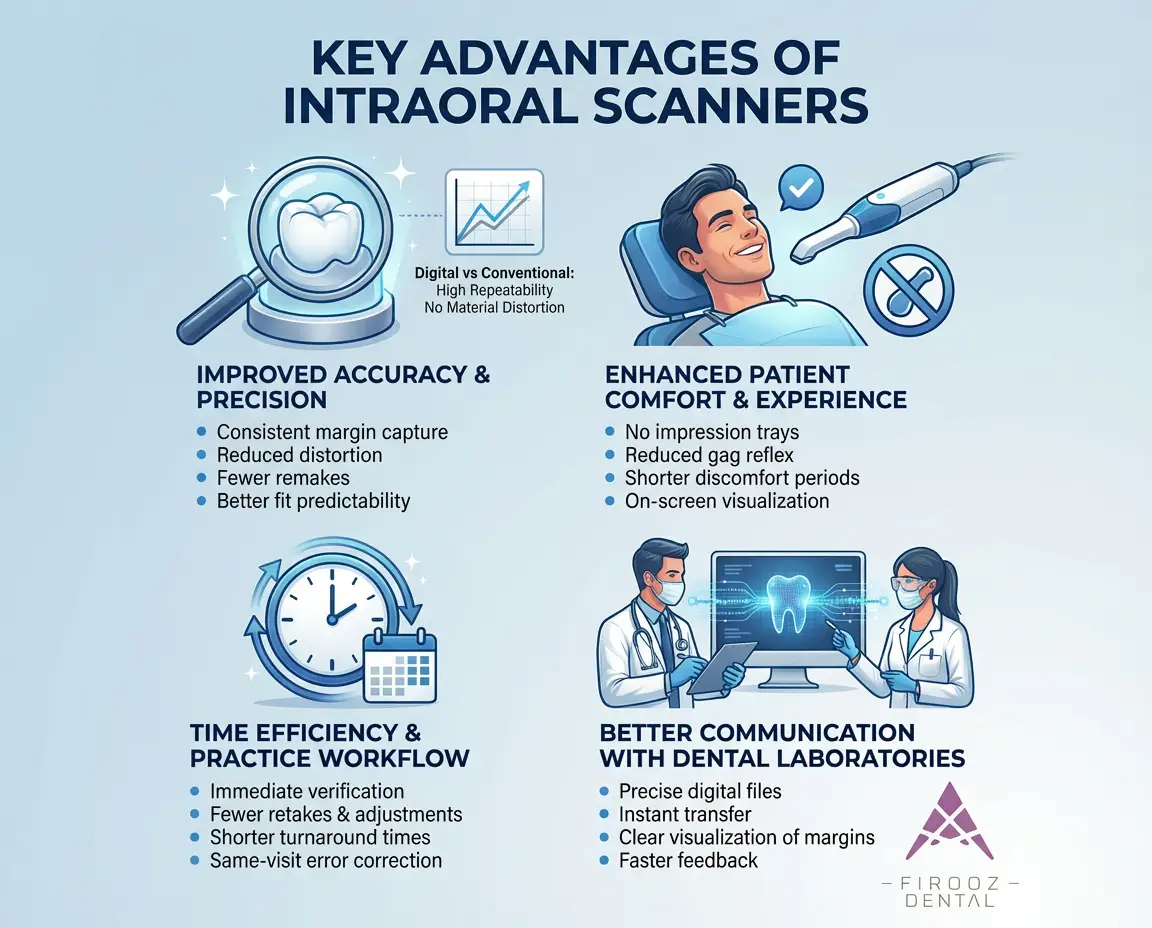
Improved Accuracy and Precision
Accuracy is the primary reason many dentists consider digital impressions. Intraoral scanners capture a dense series of optical images that are combined into a three-dimensional model, reducing several sources of error that are common with conventional impression materials. Factors such as material shrinkage, tray distortion, and delayed pouring are removed from the process.
Clinical research consistently shows that digital impressions perform well for single units, short-span restorations, and implant-supported work when correct scanning protocols are followed. Operator technique still matters, but variability between impressions is generally lower than with elastomeric materials.
Key clinical advantages related to accuracy include:
- More consistent margin capture in crown and bridge cases
- Reduced distortion in short-span implant impressions
- Fewer remakes caused by impression defects
- Better fit predictability when used within a digital workflow
“Intraoral scanners demonstrated clinically acceptable accuracy for single crowns and short-span fixed dental prostheses, with reduced distortion compared to conventional impressions.”
Journal of Prosthetic Dentistry
sciencedirect.com
Digital vs Conventional Accuracy (Clinical Overview)
| Aspect | Conventional Impression | Intraoral Scanner |
| Material distortion | Possible | None |
| Time-related changes | Yes | No |
| Margin review | Indirect | Direct, chairside |
| Repeatability | Variable | High |
| Data storage | Physical | Digital |
Enhanced Patient Comfort and Experience
Patient comfort is one of the most immediate differences noticed in clinics after adopting intraoral scanning. Traditional impression trays often cause discomfort, gag reflex activation, and anxiety, particularly in patients with limited tolerance or airway sensitivity.
Intraoral scanning replaces trays and impression materials with a handheld wand, allowing the clinician to pause, rescan specific areas, or adjust positioning as needed. This flexibility improves patient cooperation and reduces stress during appointments.
Common patient-related benefits include:
- No impression trays or setting materials
- Reduced gag reflex, especially in maxillary scans
- Shorter chairside discomfort periods
- Improved communication through on-screen visualization
From clinical experience:
Patients frequently report feeling more informed when they can see their teeth on a screen in real time. This often improves acceptance of treatment recommendations without increasing chair time.
Time Efficiency and Practice Workflow
While scanning itself may not always be faster than placing an impression tray, overall appointment efficiency often improves. Errors can be identified immediately, allowing corrections during the same visit instead of discovering problems after sending impressions to the lab.
For Canadian practices managing high overhead costs, fewer remakes and fewer follow-up appointments can have a meaningful operational impact.
Workflow-related advantages include:
- Immediate verification of scan quality
- Fewer remakes and retakes
- Reduced adjustment time at delivery
- Shorter turnaround times with digital labs
Impact on Daily Practice Flow
| Workflow Step | Conventional | Digital Scan |
| Impression check | After removal | Live, chairside |
| Error correction | New appointment | Same visit |
| Lab turnaround | Shipping required | Instant transfer |
| Record storage | Physical models | Digital files |
Better Communication With Dental Laboratories
Digital impressions improve clarity between the dental office and the laboratory. Instead of interpreting stone models or impression material quality, technicians receive precise digital files that can be reviewed, adjusted, and archived without physical degradation.
For practices working with both local and international labs, digital transfer also reduces delays and eliminates shipping risks.
Laboratory communication benefits include:
- Clear visualization of margins and preparation design
- Direct integration with CAD/CAM systems
- Reduced transcription and handling errors
- Faster feedback when adjustments are needed
Digital files also allow dentists to provide written or visual notes directly within the case submission, which improves consistency and reduces misunderstandings.
also here are some other benefits of Intraoral Scanners:
Clinical Applications Where Intraoral Scanners Excel
The clinical value of intraoral scanners depends strongly on how and where they are used. Their strengths are most evident in workflows where precision, repeatability, and digital transfer play a direct role in treatment outcomes. The sections below outline where digital impressions perform particularly well in daily practice.
Implant Dentistry
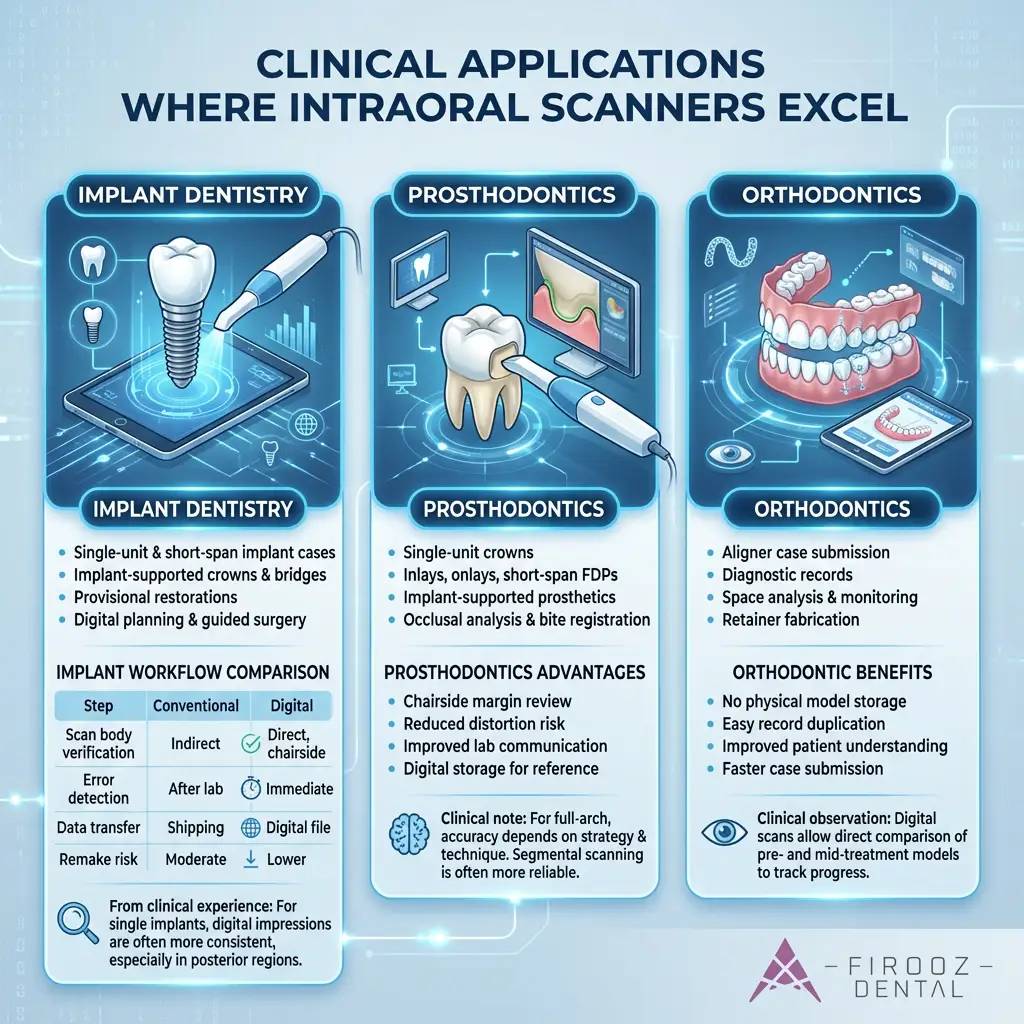
In implant dentistry, intraoral scanners are widely used for both single-unit and short-span implant cases. Their main advantage lies in accurate transfer of implant position when proper scan bodies and validated protocols are followed.
Digital impressions allow clinicians to confirm scan quality immediately and rescan localized areas if needed, which reduces the risk of positional errors that may only become visible after lab processing with conventional impressions.
Clinical applications in implant workflows include:
- Single-tooth implant impressions
- Implant-supported crowns and short-span bridges
- Provisional restorations
- Digital planning and guided surgery workflows
Clinical considerations supported by ITI guidance:
- Scan body seating must be visually verified
- Clean, dry scan fields improve data capture
- Short-span implant cases show the highest reliability
From clinical experience:
For single implants, digital impressions are often more consistent than elastomeric materials, especially in posterior regions where tray positioning can be challenging.
Implant Workflow Comparison
| Step | Conventional Impression | Digital Impression |
| Scan body verification | Indirect | Direct, chairside |
| Error detection | After lab feedback | Immediate |
| Data transfer | Physical shipping | Digital file |
| Remake risk | Moderate | Lower |
Prosthodontics
In prosthodontics, intraoral scanners are particularly effective for single crowns, inlays, onlays, and short-span fixed dental prostheses. Margin visualization is one of the main advantages, as clinicians can evaluate preparation quality in real time.
Digital impressions also allow selective rescanning without repeating the entire impression, which improves efficiency and consistency in restorative workflows.
Applications where scanners perform well:
- Single-unit crowns
- Short-span fixed partial dentures
- Implant-supported prosthetics
- Occlusal analysis and bite registration
Advantages specific to prosthodontics:
- Chairside margin review
- Reduced distortion risk
- Improved communication with dental laboratories
- Digital storage for future reference
Clinical note:
For full-arch fixed prostheses, accuracy depends on scanning strategy, operator technique, and case selection. Segmental scanning often yields more reliable results than continuous full-arch passes.
Orthodontics
Orthodontics is one of the most scanner-friendly disciplines in dentistry. Digital impressions are well suited for diagnosis, appliance fabrication, and long-term monitoring, as they allow repeatable measurements without physical models.
Digital models also improve patient communication, particularly for treatment planning and progress evaluation.
Common orthodontic uses include:
- Aligner case submission
- Diagnostic records
- Space analysis and tooth movement monitoring
- Retainer fabrication
Benefits in orthodontic settings:
- No physical model storage
- Easy record duplication
- Improved patient understanding
- Faster case submission
Clinical observation:
Digital scans allow direct comparison of pre-treatment and mid-treatment models, which helps track progress without additional impressions.
Limitations and Disadvantages of Intraoral Scanners
While intraoral scanners offer clear benefits, they are not suitable for every situation. Transparent discussion of limitations is necessary for informed decision-making, especially for Canadian practices evaluating long-term investment and workflow changes.
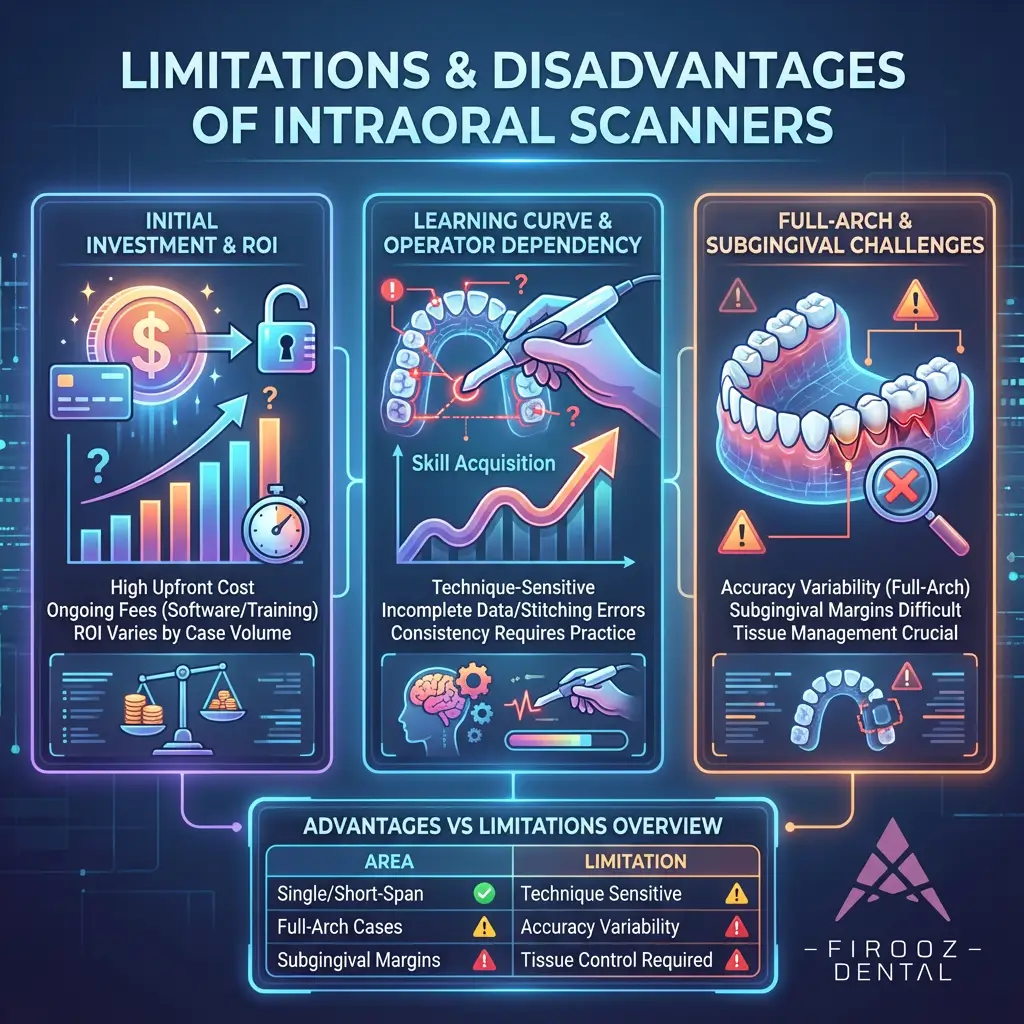
Initial Investment and ROI Considerations
The upfront cost of an intraoral scanner can be significant. In addition to the scanner itself, practices may face ongoing expenses related to software licenses, updates, and staff training.
Return on investment varies depending on:
- Case volume
- Type of procedures performed
- Level of digital integration with laboratories
Cost-related considerations:
- Equipment purchase price
- Software subscription fees
- Training time for clinicians and staff
- Integration with existing systems
From practice experience:
Clinics with a high volume of restorative or orthodontic cases tend to see faster financial return compared to practices with limited use cases.
Learning Curve and Operator Dependency
Scan quality depends heavily on technique. While scanners reduce material-related errors, they introduce operator-related variability. Inadequate scanning paths, poor moisture control, or incomplete data capture can affect outcomes.
Common technique-related challenges:
- Incomplete margin capture
- Stitching errors in longer spans
- Soft tissue movement during scanning
Key factors influencing results:
- Training quality
- Scanning protocol adherence
- Case complexity
Consistency improves with experience, but early adoption phases often involve longer appointments and increased review time.
Limitations in Full-Arch or Subgingival Scans
Full-arch digital impressions remain one of the most challenging applications. Accuracy may decrease as scan length increases, particularly in edentulous or partially edentulous arches.
Subgingival margins also present difficulties when tissue management is insufficient.
Situations where caution is advised:
- Full-arch fixed prostheses
- Deep subgingival margins
- Unstable soft tissue conditions
Advantages vs Limitations Overview
| Area | Strength | Limitation |
| Single units | High reliability | Minimal |
| Short-span bridges | Consistent results | Technique sensitive |
| Full-arch cases | Digital convenience | Accuracy variability |
| Subgingival margins | Visual review | Tissue control required |
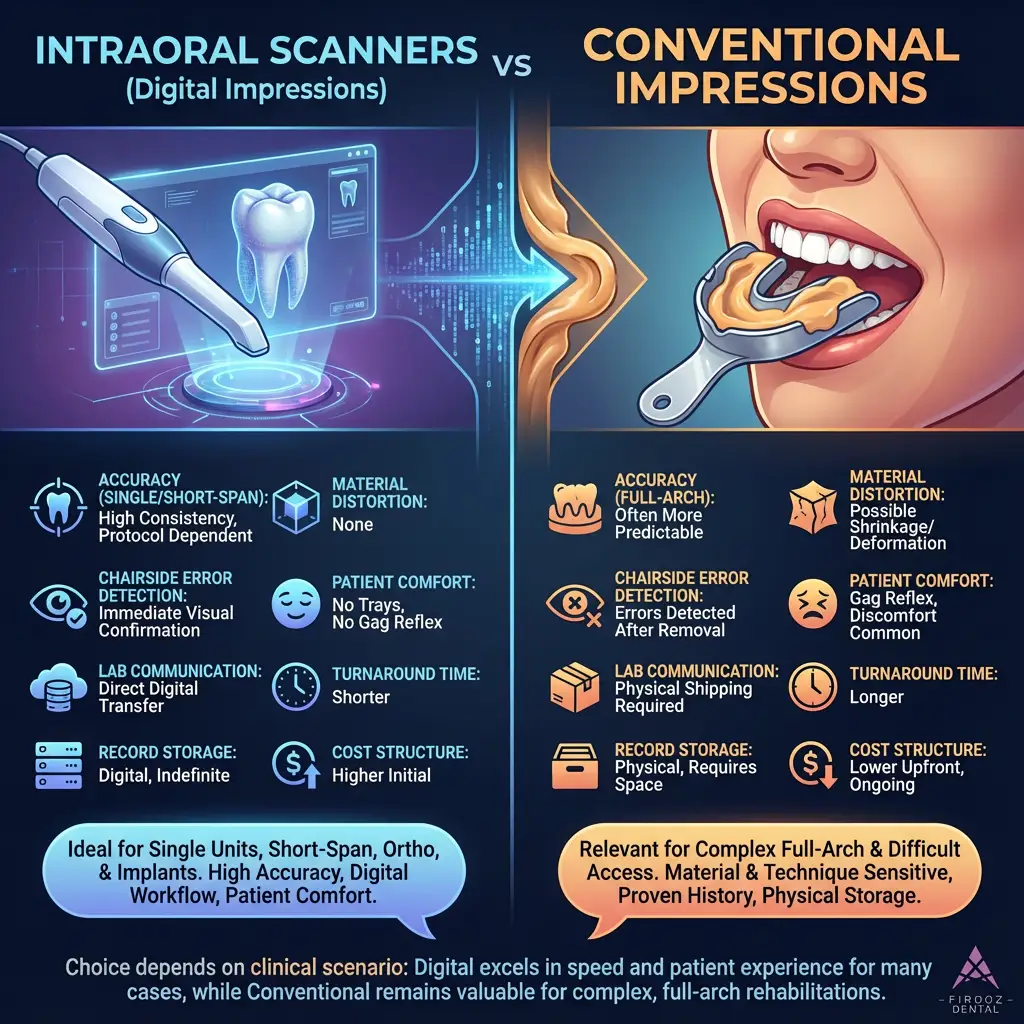
Intraoral Scanners vs Conventional Impressions
When comparing intraoral scanners with conventional impression techniques, the differences extend beyond speed or convenience. Accuracy, patient tolerance, and long-term clinical reliability are the main factors that influence decision-making in daily practice. Digital impressions remove material-related variables, while traditional methods rely on physical processes that can introduce distortion over time. However, each approach still has specific strengths and limitations depending on the clinical scenario.
| Aspect | Intraoral Scanners (Digital Impressions) | Conventional Impressions |
| Accuracy (Single Units) | High consistency when proper scanning protocols are followed | Clinically acceptable but dependent on material handling |
| Accuracy (Short-Span Bridges) | Reliable with correct scanning strategy | Reliable but sensitive to tray movement |
| Accuracy (Full-Arch Cases) | Variable; technique and scan path dependent | Often more predictable for long spans |
| Material Distortion | None | Possible shrinkage or deformation |
| Time Sensitivity | No change over time | Accuracy affected by setting time and pouring delay |
| Chairside Error Detection | Immediate visual confirmation | Errors often detected after removal |
| Remake Frequency | Generally lower | Higher due to bubbles, pulls, or tray issues |
| Patient Comfort | No trays or impression material | Gag reflex and discomfort more common |
| Appointment Experience | Adjustable and pausable during scanning | Limited once material sets |
| Lab Communication | Direct digital file transfer | Physical shipping required |
| Turnaround Time | Shorter in digital workflows | Longer due to shipping and model fabrication |
| Record Storage | Digital files stored indefinitely | Physical models require space |
| Operator Dependence | Technique-sensitive scanning | Technique-sensitive material handling |
| Cost Structure | Higher initial equipment cost | Lower upfront cost, ongoing material expenses |
| Long-Term Clinical Outcomes | Consistent results for suitable cases | Proven history with broad case types |
Digital impressions are well suited for single restorations, short-span prosthetics, orthodontic records, and many implant cases. Conventional impressions remain relevant for complex full-arch restorations and situations where scanning access or tissue conditions limit digital capture. For dental practices, choosing between these methods is less about replacement and more about selecting the approach that best fits each clinical indication.
Are Intraoral Scanners Worth It for Canadian Dental Practices?
For Canadian dental practices, the value of an intraoral scanner depends on clinical focus, case volume, and how well the device fits into existing workflows. General practices that provide a high number of single-unit restorations, short-span prosthetics, orthodontic records, or implant crowns often see clear practical benefits through reduced remakes, improved patient tolerance, and smoother lab communication. Specialist clinics, particularly in orthodontics and prosthodontics, may gain even more from consistent digital records and repeatable impressions. At the same time, the financial commitment, training requirements, and case selection limitations mean that scanners are not a universal solution. Their usefulness comes from targeted application rather than blanket replacement of conventional methods.
Last Words
Intraoral scanners offer clear clinical advantages in accuracy, patient comfort, and workflow control when used in appropriate cases. They perform especially well for single restorations, short-span prosthetics, orthodontic documentation, and many implant workflows, while still presenting challenges in full-arch and deep subgingival situations. Conventional impressions remain relevant in complex cases, but digital impressions provide a reliable alternative that reduces material-related variables and improves communication with dental laboratories. For Canadian dentists, the decision to adopt intraoral scanning should be based on clinical needs, case mix, and long-term practice goals, using digital and traditional techniques side by side to achieve consistent and predictable outcomes.