
Zirconia blocks (ZrO₂) are ceramic blanks used in dental CAD/CAM workflows to mill crowns, bridges, and other fixed restorations with consistent fit and high fracture resistance. In a typical lab process, the restoration is designed digitally, milled from a pre-sintered zirconia block, then sintered to reach final density and strength, with a known shrinkage factor that the software compensates for.
here is a summary of following content:
Compared with many glass-ceramics, zirconia is often chosen when occlusal forces are high or when a restoration needs extra margin safety especially for posterior crowns and multi-unit cases while newer high-translucency and multilayer options support more esthetic anterior work. On this category page, you can compare zirconia blocks by type (pre-sintered vs fully sintered), shading (white, pre-shaded, multilayer), and intended indication, so you can match the material to the case, your milling unit, and your sintering protocol before ordering.
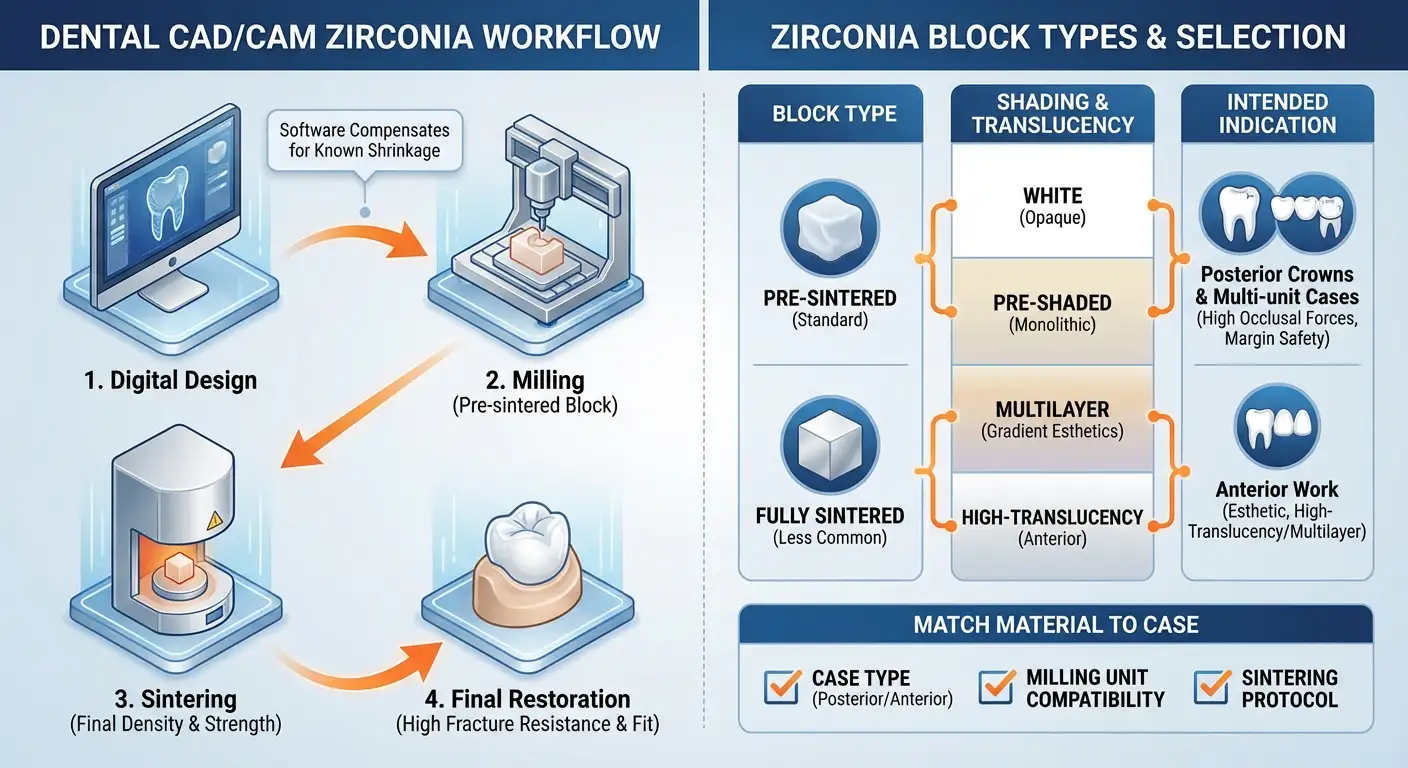
Choosing the right zirconia starts with understanding how the block is supplied (its sintering state) and how the shade and layers are built. These two factors control milling behavior, sintering workflow, final strength, translucency, and how predictable your results will be chairside and in the lab.
| Feature / Criteria | Pre-Sintered Zirconia Blocks | Fully Sintered Zirconia Blocks | Multilayer / Pre-Shaded Zirconia Blocks |
| Sintering State at Delivery | Partially densified | Fully densified | Usually pre-sintered |
| Need for Final Sintering | Yes (mandatory) | Usually no size-compensation sintering | Yes (same as other pre-sintered blocks) |
| Milling Difficulty | Easy to moderate | High (hard material) | Easy to moderate |
| Bur Wear During Milling | Low to moderate | High | Low to moderate |
| Typical Milling Mode | Dry milling | Dry milling with heavy-duty burs | Dry milling |
| Dimensional Shrinkage | Yes (≈20–25%, software compensated) | Minimal to none | Yes (same as pre-sintered) |
| Workflow Predictability | High when sintering protocol is followed | Depends strongly on milling accuracy | High if disc positioning is controlled |
| Strength Range (typical) | Depends on zirconia class (HT/ST/UT) | High but design-dependent | Depends on zirconia class and layer design |
| Translucency Options | Wide range available | Limited | Wide range with built-in gradients |
| Shade Concept | White or pre-shaded | Usually uniform | Layered shade and/or translucency |
| Esthetic Outcome | Depends on shading and finishing | More limited | Better natural transitions for visible zones |
| Best Indications | Most crowns, bridges, general lab work | Special system-specific workflows | Anterior crowns, esthetic cases, premolars |
| Common Advantages | Balanced cost, speed, compatibility | No shrinkage compensation | Reduced staining steps, natural appearance |
| Common Limitations | Requires correct sintering | Higher tool cost, slower milling | Requires precise disc/block positioning |
| Typical Buyer Profile | Most dental labs and clinics | Labs with specialized equipment | Labs focused on esthetics and efficiency |
| Relevance to CAD/CAM Workflows | Very high | Limited / niche | Very high |

What they are: Pre-sintered blocks are partially densified zirconia blanks. They are intentionally “softer” than fully densified zirconia so they can be milled efficiently. After milling, they must be sintered to reach final density and mechanical properties. Because they shrink during sintering, the CAD software applies a defined enlargement factor (based on the material’s shrinkage percentage) so the restoration finishes at the target size.
Why they dominate the market
Pre-sintered zirconia is the standard for most dental CAD/CAM workflows because it offers the best balance of:
Practical milling notes (what actually matters in the lab)
Sintering workflow (where many failures start)
Where pre-sintered is a strong choice
What they are: Fully densified (fully sintered) zirconia is already at near-final density before milling. In many cases, there is little to no post-milling sintering shrinkage step for size compensation (though some workflows still include heat treatment, staining/glazing firings, or special cycles depending on the system).
When they make sense
Fully densified zirconia can be useful when:
Limitations (why they’re less common)
Who should consider them
These describe how color and translucency are built into the blank, not whether it is pre-sintered or fully densified. Most multilayer and pre-shaded blanks in dentistry are still pre-sintered and require sintering after milling.
Multilayer zirconia (multilayer zirconia blocks)
What “multilayer” means
A multilayer blank is manufactured with gradients across the height of the disc/block often a dentin-like zone transitioning toward an enamel-like zone. Depending on the product line, the gradient may be:
Why it matters clinically
Positioning is everything
With multilayer blanks, restoration placement within the disc/block directly affects the final look:
Pre-shaded zirconia (pre shaded zirconia blocks)
What “pre-shaded” means
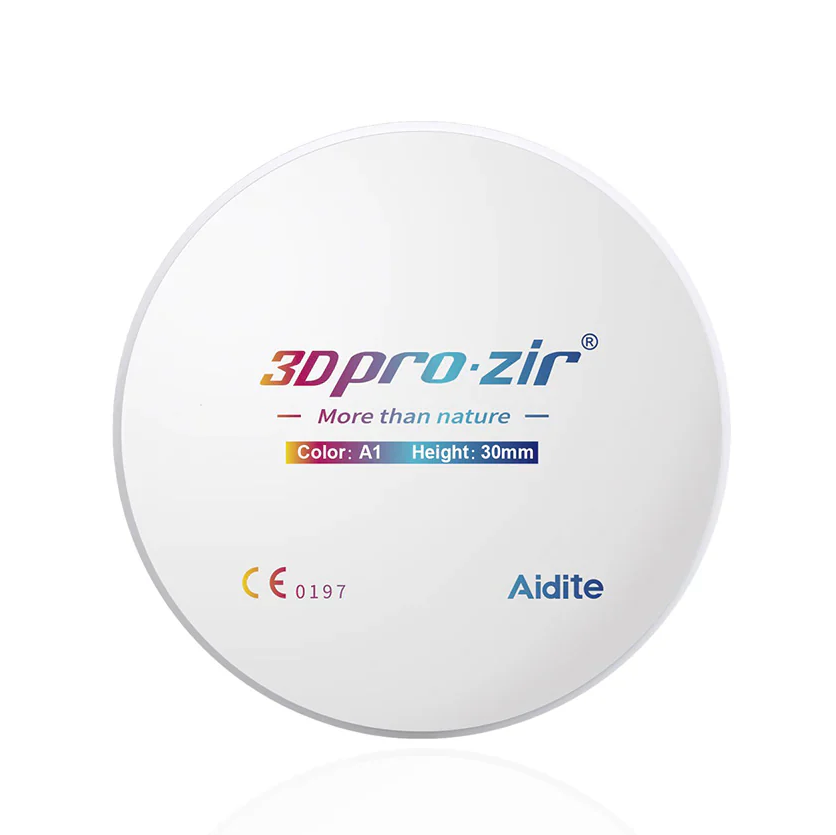
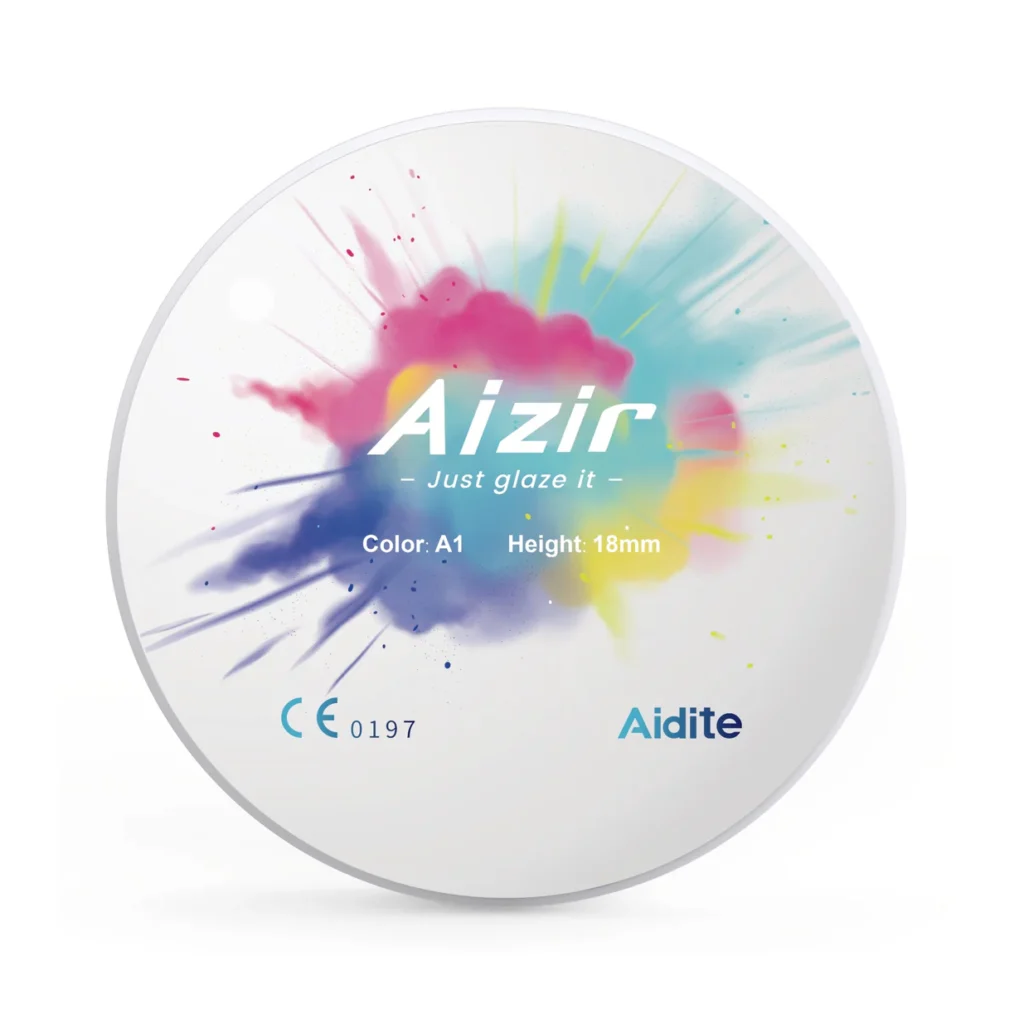
The blank is made in a single uniform shade (A1, A2, etc.) or a limited set of shades. It reduces the need for heavy shading liquids and can improve repeatability across batches when protocols are consistent.
Where pre-shaded is a good fit
Key trade-offs to know
If your category page is meant to convert, it has to do more than list products it should help the buyer avoid remakes. In day-to-day lab work, most zirconia “failures” are not caused by zirconia as a material; they come from a mismatch between case type, zirconia class (strength vs translucency), minimum thickness, and the sintering cycle.
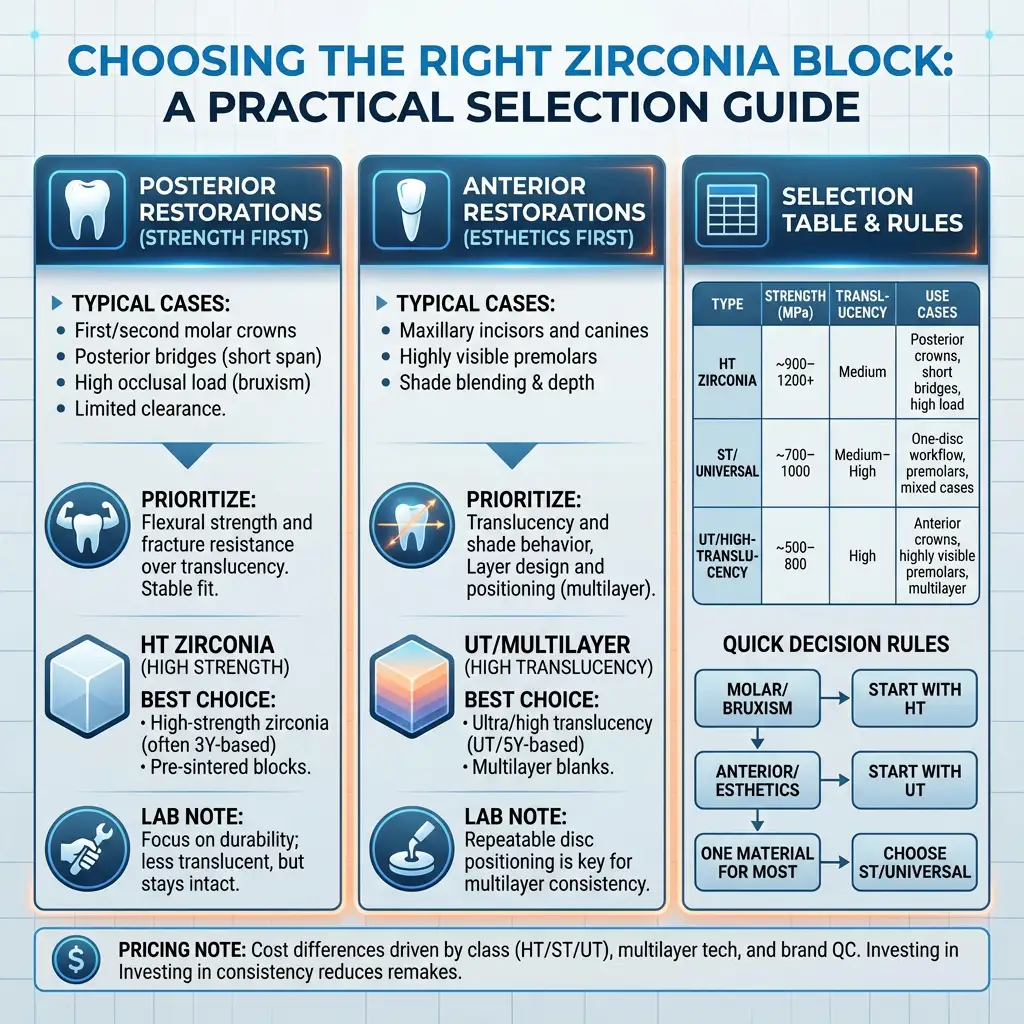
Below is a field-tested way to choose the right zirconia block based on where the restoration sits in the mouth, what forces it will see, and how demanding the esthetics are.
Typical cases
What to prioritize
What usually works best
My lab note (what I’ve seen repeatedly)
When a lab uses a very translucent zirconia for posterior crowns to “make it look nicer,” it often comes back with micro-chipping on occlusal anatomy after a period of function especially if the occlusion required heavy adjustment. For posterior, I’d rather deliver a crown that is slightly less translucent but stays intact.
Common mistakes
Typical cases
What to prioritize
What usually works best
My lab note
For single anterior crowns, multilayer zirconia can save time and reduce variability but only if your team has a repeatable habit for disc positioning. If positioning is inconsistent, two crowns from the same shade can look different.
Common mistakes
Single crowns
Short-span bridges (e.g., 3-unit)
Long-span bridges / thin connectors / implant-supported structures
Framework-style designs
Common mistakes
MPa values are typical ranges seen across product lines; always confirm the specific brand’s technical sheet and recommended indications.
| Zirconia Type (common labeling) | Typical Strength Range (MPa) | Translucency Level | Best Use Cases | Notes for Buying / Lab Workflow |
| HT Zirconia (often 3Y-based) | ~900–1200+ | Medium | Posterior crowns, short-span bridges, high-load cases | Best for durability. Slightly more opaque. More forgiving for occlusion and connectors. |
| ST / Universal Zirconia (often 4Y-based) | ~700–1000 | Medium–High | “One-disc” workflows, premolars, mixed cases, many anterior cases with controlled design | Balanced choice when you want one material for most jobs. Often a good compromise for esthetics without giving up too much strength. |
| UT / High-Translucency Zirconia (often 5Y-based) | ~500–800 (varies) | High | Anterior crowns, highly visible premolars, multilayer esthetic cases | Best visual blend, but less forgiving for heavy occlusal forces and bridge connectors. Needs careful thickness and finishing. |
Quick decision rules
When comparing zirconia block price on a Canada-based store, buyers usually see cost differences driven by zirconia class (HT vs ST vs UT), multilayer shading technology, and brand QC consistency, plus regional factors like distribution and import handling. For many labs, paying a bit more for consistent shrinkage and fewer remakes ends up costing less over a month.
Buying zirconia by shade and strength is only half the decision. The other half is system fit how well the block behaves with your scanner/software → milling unit → sintering furnace chain. Most “bad zirconia” complaints I hear in labs are really compatibility problems that show up as rough margins, micro-chipping, inconsistent shade after firing, or remakes due to fit.

Why compatibility matters (what it prevents)
When your block, milling strategy, and furnace cycle don’t match, you typically see one or more of these outcomes:
Block format and holder
Shrinkage factor and material library
Indication match
In my own production checks, the fastest way to trigger remakes is mixing a zirconia line with a “close enough” library entry. It may look fine for a few singles, then you start seeing inconsistent contacts across the week.
Dry milling basics
Tooling and wear management
Strategy and support
For multilayer and pre-shaded blanks
Use the correct furnace cycle
Spacing and support
Contamination control
Calibration and consistency
Common compatibility errors (quick checklist)
Pricing for zirconia blocks is not random. It mainly reflects how much control the manufacturer has over powder quality, pressing uniformity, presinter density, shade system, and batch consistency. For buyers, the real question isn’t “Which is cheapest?” It’s which one produces the fewest remakes per month.
1) Zirconia class (strength vs translucency)
2) Shade technology
3) Batch-to-batch consistency (the hidden cost saver)
A cheaper block that varies slightly in shrinkage, shade, or density can create:
4) Compatibility support
Some suppliers invest in:
5) Distribution and local supply chain
Because your store serves North America, Canadian market factors (import handling, distribution, and currency conditions) can influence how zirconia price is positioned compared with other regions. This is why comparing a Canada-based store price to an overseas listing without matching shipping, warranty handling, and lead time can be misleading.
A low-cost zirconia block can be perfectly fine if it is consistent and your workflow is tested for it. Problems usually start when a “budget” block leads to:
My rule when evaluating a new zirconia line: run a controlled trial on a small set of repeatable cases (same design style, same furnace, same burs), then compare remake rate and finishing time. The winner is usually not the cheapest it’s the most consistent.
A professional buyer expects three things from a zirconia category: stable results, clear selection logic, and reduced risk. That’s the purpose of this category helping you choose blocks that behave predictably across real lab workflows.

Quality control that you can feel
Brand selection with workflow in mind
Instead of listing every product without context, a strong category groups options by:
Consistent outcomes that reduce remakes
For a lab, the most valuable block is the one that:
A practical buying mindset
If you’re comparing best zirconia blocks across suppliers, focus on:
When those are in place, your team spends less time fixing problems and more time producing restorations that seat with minimal adjustment exactly what professional clinics and labs expect.
Selecting zirconia blocks is easiest when you treat the purchase like a workflow decision, not just a material choice. Match the zirconia class to the indication (strength-first for posterior and bridges, esthetics-first for anterior), then confirm the block fits your CAD/CAM chain (material library, milling strategy, and sintering cycle). When those pieces line up, you get cleaner margins, more stable contacts, fewer shade surprises, and fewer remakes results that matter more than chasing the lowest zirconia block price. For North America buyers, including Canada, it’s also worth weighing local distribution support and lead times, since consistency and uptime often save more money than a small per-block discount.
1) What is the difference between multilayer zirconia blocks and pre-shaded zirconia blocks?
Multilayer blanks have built-in transitions (typically cervical-to-incisal) in shade and/or translucency, so the crown can look more natural with less external staining. Pre-shaded blanks are usually a uniform shade throughout the block; they’re faster for consistent base color but may need more surface characterization for highly esthetic anterior cases.
2) Are all zirconia blocks compatible with all CAD/CAM milling machines?
No. Compatibility depends on the block/disc format, holder system, and whether your mill is open or restricted to certain brands. Also verify the software material library (shrinkage factor and presets). Even if a disc fits physically, a wrong preset can lead to fit issues after sintering.
3) Which zirconia type is typically better for anterior crowns?
For anterior crowns, labs commonly choose high-translucency zirconia (often labeled UT) or a multilayer version to improve light behavior and shade transitions. If the patient has high bite forces or you expect heavy adjustments, a “universal” (often ST) zirconia can be a safer compromise.
4) Why do some zirconia restorations crack after sintering?
Most post-sinter cracks come from one of these:
5) Pre-sintered vs fully sintered zirconia blocks what should I choose?
Pre-sintered zirconia is the standard for most labs: easier milling, broader options, predictable workflow when cycles are followed. Fully sintered zirconia is niche: it can reduce shrinkage concerns, but milling is harder, tool wear is higher, and it often requires a more specialized setup.
6) Does “higher translucency” always mean better zirconia?
Not always. Higher translucency often comes with lower strength. It can be excellent for esthetic anterior work, but for posterior crowns, bridges, or bruxers, a higher-strength zirconia is usually the safer choice.
7) How do I avoid shade mismatches with multilayer zirconia?
Control disc/block positioning consistently. The incisal portion should sit in the enamel zone and the cervical portion in the dentin zone. If positioning varies between cases, the same labeled shade can look different after sintering and glazing.
8) What factors most affect zirconia block price?
Price is driven by zirconia class (strength vs translucency), shade technology (white vs pre-shaded vs multilayer), batch consistency, and the level of workflow support (reliable libraries and sintering guidance). In Canada-based purchasing, distribution, import handling, and lead time can also influence final cost.
9) Why do contacts and occlusion sometimes change after sintering?
This is typically caused by using the wrong shrinkage factor/preset, inconsistent furnace performance, or deviating from the recommended cycle. Overloading trays can also create uneven heating, leading to minor distortions that show up as contact drift.
10) What should I check first if margins chip during milling?
Start with tool wear and milling strategy. Worn burs, spindle runout, overly aggressive passes, or poor dust extraction are common causes. If the same design keeps chipping, adjust the support strategy and confirm the blank is suitable for your mill’s recommended settings.